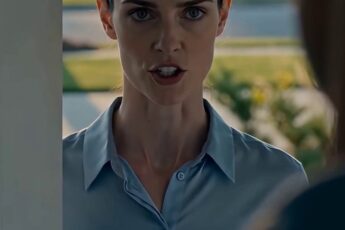
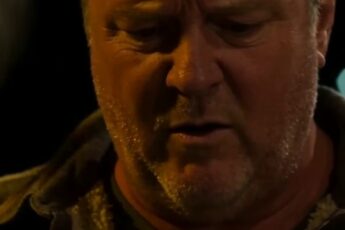
At first, the bikers thought she was waving for help.
Then they saw the child.
Then they saw the way she kept turning her head toward the desert behind her, as if the past itself were chasing her.
The highway outside a small Utah town was almost empty. The sun was sinking behind red rocks, turning the road copper. A hot wind pushed sand across the asphalt.
The leader of the ride, Frank Malloy, cut his engine first.
The others followed.
Silence fell so suddenly that the boy’s crying sounded enormous.
“Please,” the woman said. “You have to take him before the white van gets here.”
Frank’s eyes narrowed.
“What white van?”
She didn’t answer.
Instead, she kissed the boy’s forehead again and again, like she was trying to leave enough love on him to last a lifetime.
“His name is Jonah,” she said. “He’s allergic to peanuts. He hums when he’s scared. He needs his stuffed rabbit to sleep.”
The boy sobbed harder.
“No, Mommy.”
Frank took one slow step closer.
“I’m not separating you from your child.”
“You don’t know what he’ll do.”
“Then tell me.”
Her name was Claire. She had worked at a desert motel for three years. Quiet job. Quiet life. Until she saw something she was not meant to see: a man using the rooms to hide women who had nowhere else to go.
When she tried to report it, nobody believed her.
The man owned the motel.
The van.
The cameras.
And the sheriff’s campaign signs all over town.
Claire had hidden a flash drive inside Jonah’s stuffed rabbit.
That was the secret.
That was why she had run.
Frank looked at the rabbit in the boy’s arms.
Then at the woman.
Then at the long road behind her.
Headlights appeared.
A white van.
One of the bikers whispered, “You’ve got to be kidding me.”
Frank’s face hardened.
“No,” he said. “I think we’re right on time.”
He sent two riders to get Claire and Jonah behind the bikes. Another called state police, not local. A third began livestreaming quietly.
The van stopped crooked on the shoulder.
A heavy man got out, smiling like he expected obedience.
“Claire,” he said. “You’re confused. Give me the boy.”
Jonah clutched the rabbit to his chest.
Frank pointed at it.
“Funny thing about children’s toys,” he said. “Sometimes they carry more truth than grown men.”
The man’s smile disappeared.
By midnight, state police had the flash drive.
By morning, the motel was taped off.
And by the following week, Claire and Jonah were in a safe apartment with yellow curtains, donated furniture, and a kitchen table where no one shouted.
Frank visited once.
He brought a small toy motorcycle for Jonah.
Claire cried when she saw him.
“I thought I was giving my son away,” she said.
Frank shook his head.
“No, ma’am. You were giving him a chance. We just made sure you got one too.”
Years later, Jonah still kept the stuffed rabbit.
Not because it was soft.
Because inside that rabbit, his mother had hidden the truth.
And on that desert road, strangers had been brave enough to believe it.
She had already said goodbye to her son in her heart.
That was the part no mother should ever have to do.
Claire stood behind the line of motorcycles with Jonah pressed against her chest, feeling his small fingers twist into her shirt, and she knew that if those strangers did not believe her in the next few minutes, she might never again hear him say, “Mommy, I’m scared,” in that little trembling voice that still sounded half baby, half boy.
The desert wind blew sand against her ankles.
The sky had turned the color of old pennies.
And down the empty Utah highway, the white van rolled closer.
At first, Frank Malloy had thought the woman was only waving for help.
Then he saw the child.
Then he saw the way she kept looking back over her shoulder, not like someone afraid of a stranger…
But like someone who had been running from the same nightmare for too long.
“Stay behind me,” Frank said quietly.
Claire shook her head so fast her hair stuck to her wet cheeks.
“No. If he sees me hiding, he’ll get angry.”
Frank turned to her.
There was something in his eyes that made her stop talking. Not hardness. Not pity. Something steadier than both.
“Ma’am,” he said, “you don’t have to make yourself smaller for a man who already took too much.”
Claire’s lips opened, but no sound came out.
For three years, she had kept her voice soft.
Soft at the motel desk.
Soft when guests complained.
Soft when that man stood too close behind the counter and told her she was lucky to have work.
Soft when people in town looked away because trouble was easier to ignore when it belonged to someone else.
But hearing Frank say those words felt like someone had opened a locked window inside her chest.
Jonah lifted his tearful face.
“Mommy, are we bad?”
Claire looked down at him, and the question broke something in her.
She dropped to her knees right there in the dirt and held his face between her shaking hands.
“No, baby,” she whispered. “No. Listen to me. You are good. You are so good. And I am sorry I didn’t say that louder every single day.”
The boy’s lower lip trembled.
His stuffed rabbit was squeezed under one arm, gray from years of bedtime, car rides, cereal spills, and tiny hands that needed something to hold when the world felt too big.
Frank glanced at that rabbit.
A soft toy.
A child’s comfort.
And hidden inside it, Claire had placed the only truth anyone might believe.
The van stopped crooked on the shoulder.
Dust drifted around its tires.
The driver’s door opened slowly, as if the man inside wanted every person there to feel his arrival.
He stepped out with a smile.
Not a friendly smile.
A practiced one.
The kind of smile that had fooled people at front desks, diners, gas stations, and small-town offices. The kind that made a frightened woman look “confused” and a powerful man look “concerned.”
“Claire,” he called, spreading his hands. “There you are. Everyone’s been worried.”
Claire’s body went stiff.
Jonah buried his face in her neck.
Frank heard the child start humming.
Low. Broken. Barely there.
Claire had told him that Jonah hummed when he was scared.
Now the sound came out of the boy like a tiny prayer.
Frank stepped forward.
The other bikers moved with him, not loud, not dramatic, just a wall of denim, leather, tired faces, gray beards, sunburned arms, and men who had lived long enough to recognize fear when it stood in front of them.
The man from the van looked around at them and gave a small laugh.
“What is this supposed to be?”
Frank didn’t answer right away.
He took off his sunglasses and tucked them into his vest.
Then he said, “Looks to me like a woman asked for help.”
The man’s smile tightened.
“She’s upset. She doesn’t always understand what she’s doing.”
Claire flinched.
Just a little.
But Frank saw it.
So did the woman biker beside him, a quiet rider named Marlene, who had silver hair braided down her back and eyes that missed nothing.
Marlene turned and gently touched Claire’s elbow.
“You hear me?” she said softly. “Don’t let him tell your story for you.”
Claire swallowed.
Her throat felt full of sand.
For years, she had lived in the space between what she knew and what others refused to see.
She remembered the motel laundry room at midnight.
The smell of bleach.
The buzzing fluorescent light.
The woman with the bruised suitcase sitting on the floor, whispering, “Please don’t tell him I was here.”
Claire remembered wanting to help, but not knowing how.
She remembered writing dates on napkins and hiding them inside an old coffee tin.
She remembered calling once, twice, three times, and being told there was nothing to prove.
Then she remembered the flash drive.
The one she had copied in secret while Jonah watched cartoons in the tiny back room behind the motel office.
The one she had hidden inside his rabbit with clumsy stitches and shaking hands.
Because who would look inside a child’s toy?
The man pointed toward Jonah.
“Give me the boy.”
Claire’s arms tightened around her son.
“No.”
It came out small.
Almost lost in the wind.
The man took one step closer.
Frank’s voice cut through the air.
“That’s far enough.”
For the first time, the man looked irritated.
“You have no idea what you’re getting involved in.”
Frank looked at the white van.
Then at Jonah’s rabbit.
Then at Claire, whose face had gone pale but whose arms had not loosened.
“I think I do.”
One of the younger bikers, Luis, stood near the back with his phone held low, recording everything.
Another rider had already made the call Claire had been too afraid to make again.
Not to anyone in town.
Farther away.
Higher up.
Someone who would not be invited for coffee by the man from the motel.
The man’s eyes flicked toward the phone.
That was when his smile disappeared completely.
Claire saw it.
That tiny change.
And suddenly she understood something that almost made her knees give out.
He was not invincible.
He had only taught everyone to act like he was.
Jonah’s humming grew louder.
Claire kissed his temple.
“I’m here,” she whispered. “Mommy’s here.”
The man tried to laugh again, but there was no warmth left in it.
“Claire, think about what you’re doing. Think about your son.”
She looked up then.
Slowly.
For the first time in a long time, she did not lower her eyes.
“I am,” she said. “That’s why I ran.”
The words landed harder than shouting.
Even the wind seemed to pause.
Marlene’s eyes filled with tears, but she blinked them back and stood closer.
Frank nodded once, like a man hearing the truth and choosing to stand beside it.
In the distance, new lights appeared.
Not one vehicle this time.
Several.
Blue and white flashes cutting through the desert dusk.
The man turned his head.
And Claire felt Jonah’s little body relax by half an inch.
It was not over.
Not yet.
But for the first time, the road behind her was no longer empty.
People stepped out of the arriving cars with firm voices and careful hands. They spoke to Claire gently. They asked her name. Jonah’s name. Whether the boy needed water. Whether she was hurt.
No one called her confused.
No one told her to calm down like her fear was inconvenient.
And when one woman in a plain navy jacket knelt in front of Jonah and said, “May I see your rabbit for just a minute, sweetheart?” Claire almost broke.
Jonah shook his head hard.
“No. Bunny sleeps with me.”
The woman nodded.
“That’s okay.”
Frank crouched beside him with a groan in his knees.
“Jonah,” he said, “you like motorcycles?”
The boy peeked out from behind Claire’s hair.
“A little.”
Frank gave a serious nod.
“Well, I need to tell you something important. Real bikers always take care of their crew. And tonight, Bunny is part of the crew.”
Jonah sniffed.
“He is?”
“Oh, absolutely.”
The boy looked at the rabbit.
Then at Frank.
Then at his mother.
Claire brushed his damp hair from his forehead.
“Baby,” she whispered, “Bunny helped Mommy keep something safe. And now Bunny is going to help other people too.”
Jonah’s face crumpled.
“But will he come back?”
The woman in the navy jacket softened.
“I promise we will be very careful with him.”
Frank held out his hand, palm up, not reaching, not taking.
Just waiting.
That was what finally made Claire cry.
Because nobody had waited before.
People had pushed.
Demanded.
Explained over her.
Decided for her.
But this stranger with weathered hands and dust on his boots simply waited for a frightened child to be ready.
Jonah kissed the rabbit’s nose.
Then he gave it to Frank.
“Don’t let him be scared,” he whispered.
Frank’s jaw tightened.
He stood slowly, holding that worn little toy like it was something holy.
“I won’t.”
Later, Claire would remember the night in pieces.
A blanket around her shoulders.
A paper cup of water she could barely hold.
Marlene sitting beside her on the roadside, rubbing slow circles between her shoulder blades the way an older sister might.
Jonah asleep in her lap, his face sticky from tears, one hand still reaching for a rabbit that was not there.
Frank standing a few feet away, speaking quietly to the people who had arrived, his face grave beneath the flashing lights.
And the man from the van no longer smiling.
By midnight, the truth inside the rabbit had been found.
Names.
Dates.
Recordings.
Enough to open doors that had been locked for too long.
Enough to make people finally listen.
Enough for Claire to stop being “the woman who imagined things” and become what she had always been:
A mother trying to save her child.
A woman trying to save others too.
By morning, the motel’s glowing sign was dark.
The curtains in the rooms no longer moved.
The office door was sealed.
And Claire, who had spent years wiping down that counter, folding towels, counting change, and pretending not to be afraid, sat in the backseat of a quiet car with Jonah asleep against her side.
The sunrise came slowly over the desert.
Pink first.
Then gold.
Then the kind of light that makes even broken things look possible again.
Jonah woke when they stopped at a small diner outside town.
He blinked at the window.
“Where’s Bunny?”
Claire’s heart twisted.
Before she could answer, Frank appeared beside the car with a small paper bag in one hand and the rabbit in the other.
Jonah gasped.
“Bunny!”
He grabbed it so fast that everyone laughed, even Claire, though her laugh came out wet and shaky.
Frank handed her the bag.
Inside were two warm muffins wrapped in napkins.
“I figured you both forgot dinner,” he said.
Claire stared at the muffins as if she had never seen food before.
Something about that simple kindness nearly undid her.
Not the flashing lights.
Not the questions.
Not even the moment the truth came out.
But two muffins in a paper bag from a man who barely knew her.
Her hands trembled.
“I don’t know how to thank you.”
Frank looked uncomfortable, the way good people often do when someone names their goodness out loud.
“You don’t have to.”
“Yes,” Claire whispered. “I do.”
Jonah pressed the rabbit to his cheek.
“Thank you for saving Bunny.”
Frank smiled then.
A tired, gentle smile.
“Well, Bunny did most of the saving.”
Claire looked at her son.
At his small knees sticking out from his shorts.
At the dust still clinging to his socks.
At the way he leaned into her without fear for the first time since they had run.
And she said the words she had swallowed for too long.
“I’m sorry, Jonah.”
The boy looked up.
“For what?”
“For every night I told you everything was fine when you knew it wasn’t. For making you be brave when you should have only been little.”
Jonah thought about this with the seriousness only children have.
Then he touched her cheek.
“You came back for me.”
Claire closed her eyes.
Those five words went through her like light.
Because mothers carry so much blame.
For what they did.
For what they didn’t know.
For what they couldn’t stop.
For the nights they cried quietly in bathrooms with the faucet running so their children wouldn’t hear.
For the times they smiled at breakfast with a heart full of fear.
But sometimes a child remembers only the one thing that matters most.
You came back for me.
Claire pulled him close and whispered, “Always.”
The safe apartment they were given a week later had yellow curtains in the kitchen.
They were too bright, honestly.
The sofa sagged in the middle.
One chair at the table wobbled if you leaned too far to the left.
The plates did not match.
The bedroom lamp buzzed softly for the first ten minutes after you turned it on.
But to Claire, it felt like a palace.
Because no one had a key except her.
Because Jonah could leave his toy cars on the floor without being told to hide them.
Because the hallway did not smell like fear and old motel carpet.
Because when someone knocked, Claire could choose whether to open the door.
The first evening there, she made scrambled eggs and toast because that was all she knew how to cook with her hands still shaking.
Jonah sat at the kitchen table with Bunny propped beside his plate.
“Bunny wants toast too,” he said.
Claire put a tiny square of toast on a napkin in front of the rabbit.
“There,” she said. “For the hero.”
Jonah giggled.
The sound filled the kitchen.
Claire turned toward the sink quickly, pretending to rinse a spoon, because she did not want him to see her cry again.
But he did see.
Children always do.
He climbed down from the chair, came behind her, and wrapped his arms around her legs.
“Mommy?”
“Yes, baby?”
“Are these happy tears?”
Claire looked out the small kitchen window.
The sunset was soft and pink, not harsh like the desert road.
A woman in the next building was watering plants on her balcony.
Somewhere, someone was frying onions.
Life was going on.
Ordinary, simple, beautiful life.
“Yes,” Claire whispered. “I think they are.”
A few days later, Frank came by.
He did not arrive with a crowd or noise.
Just one motorcycle at the curb, one small box under his arm, and that same awkward kindness in his face.
Jonah ran to the door first.
“Mr. Frank!”
Claire opened it and saw him standing there with a toy motorcycle, black and silver, shiny enough to make Jonah’s eyes go wide.
“I saw it at a gas station,” Frank said. “Figured every brave kid needs one.”
Jonah held it like treasure.
Claire invited him in for coffee.
The apartment smelled like apples because she had been trying to bake something from a recipe she found on her phone. The edges were a little too brown. The middle was too soft. But when Frank took a bite, he nodded like it was the finest thing anyone had ever served him.
“My wife used to burn the edges too,” he said.
Claire looked up.
“Used to?”
Frank’s fingers rested around the coffee mug.
For a moment, the old biker looked less like a wall and more like a tired man carrying his own invisible rooms.
“She passed six years ago.”
“I’m sorry.”
He nodded.
“Me too.”
Jonah played on the rug, making motorcycle sounds under his breath.
Claire lowered her voice.
“Did you have children?”
“A daughter,” Frank said. “We didn’t speak for a long time.”
Claire waited.
“She thought I judged her choices. Maybe I did. Maybe I was too proud to say I was scared for her. People lose years that way.”
His eyes moved to Jonah.
“After that night on the road, I called her.”
Claire felt her throat tighten.
“And?”
Frank smiled faintly.
“She answered.”
Sometimes second chances do not arrive with music or grand speeches.
Sometimes they arrive as a phone ringing in a quiet room.
A daughter saying, “Dad?”
A father saying, “I should have called sooner.”
A mother telling her child, “I’m sorry.”
A little boy answering, “You came back for me.”
Words said in time can become bridges.
Words held too long can become walls.
Claire learned that in the months that followed.
She learned it while filling out forms with patient women who spoke gently.
She learned it while Jonah started sleeping through the night again.
She learned it when Bunny needed another stitch and Jonah brought the rabbit to her like a little wounded soldier.
She learned it the first time she laughed without looking over her shoulder.
And she learned it when she finally stood in front of the mirror one morning, hair messy, eyes tired, wearing an old T-shirt with flour on the sleeve, and whispered to the woman looking back:
“You did not fail him.”
It took her a long time to believe it.
But slowly, she did.
Years later, Jonah still kept the stuffed rabbit.
It sat on a shelf above his desk, one ear softer than the other, one seam carefully repaired with blue thread because that was the only color Claire had in the apartment that first week.
He grew taller.
His voice changed.
He stopped needing the night-light.
But every once in a while, especially when life felt heavy, he would take that rabbit down and hold it for a minute.
Not because it was soft.
Because inside that rabbit, his mother had hidden the truth.
And on a desert road, a group of strangers had been brave enough to believe her.
On Jonah’s eighteenth birthday, Claire made apple cake in the same small kitchen, though by then the curtains had faded from bright yellow to pale cream.
Frank was there too, older now, moving slower, sitting at the table with a cup of tea because coffee kept him awake.
Marlene brought flowers.
Jonah’s friends crowded the living room.
Someone laughed too loudly.
Someone spilled juice.
The cake leaned a little to one side.
And Claire stood by the stove, watching her son cut the first slice.
For a second, she saw him as he had been that night.
Dusty socks.
Tearful eyes.
Bunny clutched under one arm.
“No, Mommy.”
Then Jonah looked over at her, tall now, smiling softly.
“You okay?”
Claire nodded.
But tears slipped down anyway.
Jonah crossed the kitchen and hugged her in front of everyone.
Not a quick hug.
Not an embarrassed one.
A real one.
The kind that says, I remember.
The kind that says, I know what you did for me.
The kind that says, you can stop running now.
Frank looked down at his tea.
Marlene wiped her eyes with a napkin and pretended not to.
The room grew quiet in that tender way families understand, even when they are not all related by blood.
Outside, rain began tapping softly against the window.
Inside, the kitchen was warm.
The lamp over the table glowed gold.
Steam rose from the cups.
Apple and cinnamon filled the air.
On the table, beside the birthday cake, lay an old stuffed rabbit with one blue-stitched seam.
Claire touched it with two fingers.
Then she looked at her son and finally said the words she wished every frightened mother could hear before she breaks herself trying to be strong:
“Love saved us, Jonah. Not fear. Not running. Love.”
Jonah held her tighter.
And for the first time in many years, Claire believed that the road behind her was truly behind her.
Because sometimes a mother’s love is not loud.
Sometimes it is a hidden flash drive in a child’s toy.
A kiss pressed to a forehead in the middle of terror.
A whispered apology at a diner table.
A hand that keeps holding on when everything else falls apart.
And sometimes, the right words spoken at the right moment can give a family its life back.
Have you ever had someone believe you at the exact moment you needed it most?