
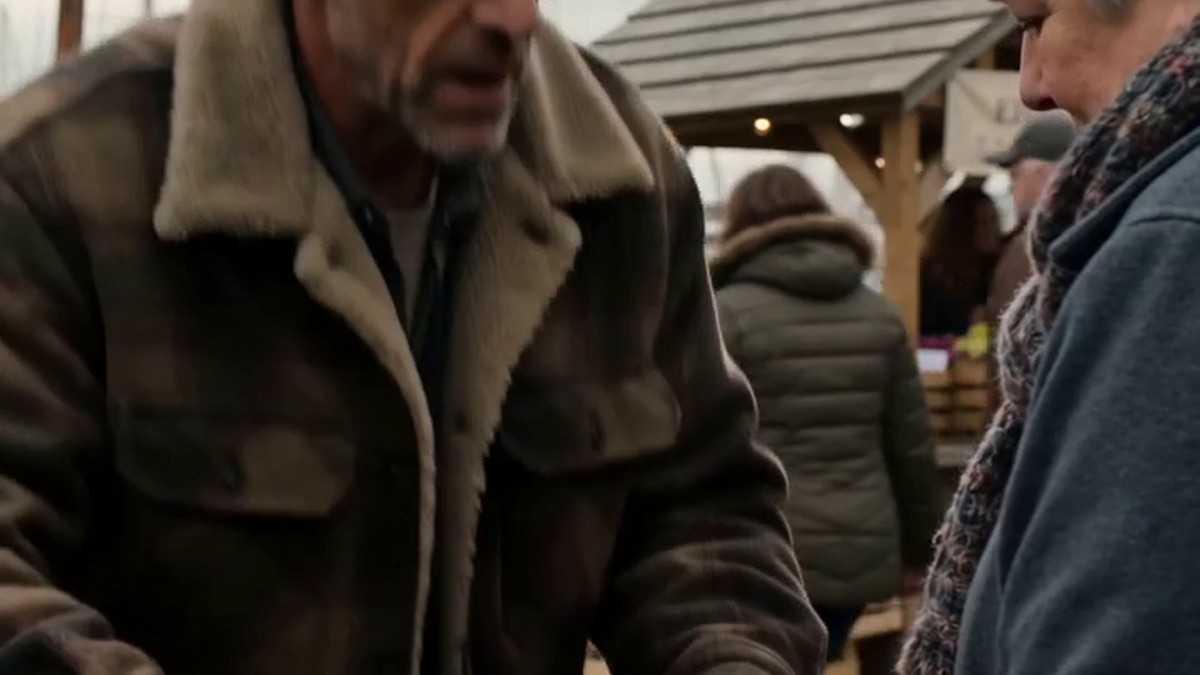
The cardboard box had been at Evelyn’s feet for three days, and the bottom was already going soft from the damp October air. She’d lined it with an old flannel shirt, but the chill crept up through the asphalt of the Harbor Farmers’ Market and settled into her bones. Five kittens—two gray, two tiger-striped, one black with a white bib. The black one was always asleep, the stripes tumbled over each other, the grays pressed together like they were still in the womb.
Evelyn’s son, Kyle, was driving up from Boston on Saturday. He’d take the mother cat, he said, but not the litter. “Mom, I’ve got a studio apartment. Five kittens? Be reasonable.” And he was right, of course. His rightness didn’t make the box any lighter.
“Would you like a kitten?” she said to every person who glanced her way. “They’re weaned, they use the litter box. Please, if you have room…”
A woman pushing a stroller gave a sympathetic grimace. A guy in coveralls walked past like she was invisible. A little girl squatted down, hand reaching, but her mother tugged her away before her fingers touched fur.
The man didn’t slow down. He just stopped, like he’d walked into a glass door, and stared at the box. He was tall, wiry, a fleece jacket with worn cuffs, hands in his pockets. His face had that hollowed-out look of someone who’d been sleeping badly for reasons that had nothing to do with work. Dark circles under pale eyes. A three-day stubble that seemed less a choice and more a forgetting.
“How many?” he asked.
“Five,” Evelyn said, straightening up. “Two boys, three girls. About eight weeks. Very sweet, if you’re interested in just one—”
“All of them. I’ll take all of them.”
Evelyn blinked. “I’m sorry?”
He crouched down, pulled his hands from his pockets, and picked up the black kitten. He didn’t just scoop it up; he turned it over, checked the gums, gently spread the back legs, peered at the eyes. He was examining it like a doctor. Evelyn had seen that once before, when her own cat had been sick and the vet had moved the same way—swift, sure, looking for something specific.
“You… all five?” she said.
He nodded. He lifted the whole box, tucking it against his chest like it held something precious. His fingers didn’t squeeze; they cradled.
“Wait,” Evelyn said, fumbling in her tote. “Here, there’s kitten formula. The black one still needs supplement feeding, every few hours. He’s the runt.”
He took the bag of supplies. He didn’t smile, didn’t say thanks. Just nodded again and walked away, the box rocking gently, a tiny orange-striped paw poking over the edge.
The woman at the next stall leaned over. “All of ’em? That’s weird. You sure he’s not some kind of—?”
Evelyn didn’t answer. She grabbed her notebook and followed him. He didn’t go far—around the corner, down a side street, into a little blue house with a sagging porch and a mailbox that read “C. Whitman.” She scribbled the address down before she could talk herself out of it. Then she stood there on the sidewalk, feeling foolish and cold and not at all relieved.
The house smelled of dust and coffee. Ben—Carver Whitman, but nobody had called him anything but Ben since his wife died—set the box on the kitchen linoleum. The radiator under the window clicked and sputtered, still waking up for the season. It was barely warm, so he pulled a threadbare bath towel from the hall closet, the one that used to be navy blue and now was the color of a bruised sky, and laid it on the floor by the heat. Then he transferred the kittens one by one from the box to the towel.
They piled together in a heap, legs tangled, tiny ribs rising and falling. The black one—the runt—lifted its head and fixed its murky green eyes on him. Ben got the formula from the bag, mixed it with warm water, tested the temperature on his wrist the way he’d done ten thousand times in the clinic. The pipette felt like an extension of his own hand.
A year ago, he’d closed the practice. Packed up the instruments, handed the keys to the landlord, walked away. Kate had died in April, and by October he couldn’t look at a sick dog without seeing the hospital bed. So he’d stopped looking. But his hands remembered.
He fed the black one first, cradling it on its back, the pipette at its lips. Milk dribbled down its chin onto the towel, and it made a tiny, satisfied clicking noise. One by one he fed them all, the gray siblings head-to-head, the stripes wriggling and complaining, and when he was done he sat on the cold floor with his back against the cabinet and listened to them breathe. It was a soft, rapid, collective sound, like rain on a tin roof.
Evelyn showed up on the fourth day. Ben’s doorbell had been broken since the spring, but he heard the knock—three short, uncertain raps. He opened the door to find her standing there in the same wool scarf, this time neatly tied, holding a Tupperware container that smelled like warm butter and apples.
“Hello,” she said, and then, fast, “I’m not staying. I just wanted to see how they are. The kittens.”
Ben stepped aside. She walked in, her eyes going straight to the kitchen. There on the floor was the towel, the kittens, and four small bowls marked in black Sharpie: “Blackie,” “Gray 1,” “Gray 2,” “Tiger Boy,” “Tiger Girl.” The runt was perched on Ben’s shoulder, claws hooked into his sweatshirt, a dozen new snags already threading the fabric.
Evelyn’s throat tightened. A man who labels bowls on the fourth day isn’t planning to give them away.
“I brought apple crisp,” she said, holding out the container. “I thought maybe… you might not cook much.”
He took it. “I don’t. Coffee?”
She nodded. She sat on a wooden stool, hands folded on her knees. The kitchen was warmer than the porch, and it smelled of milk and floor cleaner and something else—something faintly medicinal, like the back room of a vet’s office. The black kitten scrambled down from Ben’s shoulder and into her lap, and she caught it automatically, her palm pressing its warm back, feeling the frantic little heartbeat against her fingers.
Ben poured coffee into two mugs that didn’t match. He didn’t ask how she found him. Maybe he already knew.
Over the next week, the cardboard box became irrelevant. The kittens slept everywhere: the windowsill, the armchair, a pile of laundry Ben had left on the floor. He flattened the box and used it as a mat by the back door. Every morning he fed them, weighed them on a kitchen scale, checked their eyes and ears. The runt gained three ounces. The tiger girls went from shy to feral little wrecking balls.
Evelyn came every other day, bringing zucchini bread, a quiche, a bag of apples from the market. She started staying for coffee, then for lunch. He fixed the doorbell. She’d press it, and the sound—a rattling old chime—cut through the silence that had filled the house since Kate’s death. One afternoon, she noticed a photograph on the mantle: a woman with windblown hair, laughing on a sailboat. Ben caught her looking and said, quietly, “My wife. She loved the water.” Evelyn didn’t say anything, just reached over and straightened the frame a millimeter.
By the end of the month, her scarf hung on a hook by the door, next to his jacket. The kittens didn’t startle anymore when she walked in. They just opened one eye, yawned, and went back to sleep.
Then Kyle came.
He pulled up in his silver Subaru on a gray Saturday morning, earlier than expected. Evelyn was in Ben’s kitchen, helping mix the morning feed. The knock wasn’t hesitant this time—it was three hard pounds. Ben opened the door to a young man in an expensive parka, holding a cat carrier and looking impatient.
“Is my mom here? Evelyn’s car’s out front. I’m Kyle. I’m supposed to pick up the cat, the mother. She said the kittens were gone, but I saw the sign at the market—someone told me a guy took all five. That you?”
Ben didn’t step aside. “They’re here. They’re not going anywhere.”
Kyle’s jaw tightened. “Look, my mom’s been worrying herself sick. Are you even capable of taking care of all of them? This place—” he gestured at the peeling porch, the cluttered hallway “—doesn’t exactly scream ‘great home.’ I could take them to the shelter, they’ll find proper homes.”
“Kyle, stop.” Evelyn appeared in the doorway, the black kitten in the crook of her arm. “I told you, they’re in a good place.”
“What, here? With him? Mom, you don’t even know this guy.”
Ben didn’t move. His voice was low and steady. “I was a veterinarian for twenty-three years. That runt on your mom’s arm needed supplementary feeding every three hours for the first week—I kept a log. They’ve all been dewormed, vaccinated, and the black one had an eye infection I treated with terramycin ointment. They’re not a burden. They’re the reason I get up in the morning.”
Kyle blinked. The carrier dangled from his hand. “A vet?”
“I closed my practice after my wife died,” Ben said. “I thought I was done. Then your mom stood in the market with a box of kittens, and… I don’t know. Something switched back on.” He looked at Evelyn, and for the first time since she’d met him, he smiled—just a small curve at the corner of his mouth. “She brings apple crisp. I do the shots.”
Evelyn felt her cheeks flush, but she didn’t look away.
Kyle stood there, the November wind cutting through his parka. He stared at the man, then at his mother, then at the five kittens who had by now all wandered into the hallway to see what the commotion was about. A striped one attacked his shoelace.
“Fine,” Kyle said at last, his voice deflating. “Fine. But the mother cat? She’s still mine.”
Evelyn opened her mouth, but Ben spoke first. “How about we keep her here, too? She belongs with the litter. You can visit whenever you want.”
Kyle hesitated. He looked at his mother, who was beaming now. “Alright,” he muttered. “But I’m not paying vet bills.”
“I think I can cover it,” Ben said, and this time the smile reached his eyes.
An hour later, Kyle drove off with an empty carrier and a container of apple crisp his mother had insisted on giving him. Evelyn stood on the porch, watching the Subaru disappear. Ben came up beside her, a gray kitten perched on his shoulder.
“You said they’re the reason you get up in the morning,” she said quietly.
“Not the only reason.”
She turned to look at him. The November sky was iron-colored, and the first snowflake drifted down between them, landing on the kitten’s ear. It flicked the ear, annoyed, and Ben laughed—a real, surprised laugh, as if he’d forgotten he could.
Evelyn didn’t say anything. She just reached up and brushed the snow off his sleeve, her hand lingering a moment longer than necessary. Then she turned and went back inside, leaving the door open behind her. He followed, shutting it softly, and the last thing visible through the window was the black kitten pouncing on the flattened box by the door, skidding sideways, and scrambling back for another attack.





