
I was ten months old when my parents died.
Not in a fire or some dramatic movie scene. Just a slick highway outside Phoenix and a semi that jackknifed in the rain. My grandma lost her only daughter that night. And then she walked into a hospital nursery, picked up a screaming baby in a too-big onesie, and decided her life wasn’t over yet.
She was sixty-three. Widowed. Living on a retired schoolteacher’s pension. And suddenly raising an infant.
By the time I hit high school, Grandma Ruth was the only parent I’d ever known. She came to every parent-teacher conference with a little spiral notebook. She sat in the bleachers at my terrible volleyball games, the ones where I spent more time on the bench than the court. She taught me to parallel park in a cemetery because, in her words, “If you can dodge tombstones, you can dodge a Honda Civic.”
When I was twelve, we watched some cheesy prom movie on cable. The kind where the girl walks down a staircase in a poufy dress and everyone gasps.
“You think you’ll go to one of those someday?” Grandma asked, squinting at the screen.
“I dunno. Seems dumb.”
She laughed. “Well, if you do, I’m coming with you. Even if they have to roll me in on tractor wheels.”
I threw a pillow at her. We both cracked up.
Four years later, she had the stroke.
It happened on a Tuesday afternoon in the produce section of a Safeway. She collapsed next to the cantaloupes. The doctors said she was lucky to be alive. The right side of her body didn’t agree. Her arm hung useless. Her leg forgot how to hold weight. She moved from her bedroom to a hospital bed we set up in the living room, and the wheelchair became a permanent fixture by the front door.
She never complained. Not once. The only thing that changed was the light in her eyes—it got a little dimmer, like someone had turned a dial.
Senior year. Prom talk started in October because our school was insane about it. Girls in my homeroom were already booking hair appointments. Couples were doing those elaborate “promposals” in the cafeteria with poster boards and roses.
I didn’t think twice about my date.
I asked Grandma on a Sunday morning while I was helping her with breakfast. Scrambled eggs, toast cut into triangles, coffee with exactly two sugars.
“I want you to come with me. To prom.”
She looked at her lap for a long time.
“People will stare, sweetheart. They’ll look at the chair instead of you. I don’t want to ruin your night.”
“You told me once you’d come even if they had to roll you in on tractor wheels.”
“I was joking.”
“I wasn’t.” I slid the coffee mug closer to her good hand. “You’ve been at everything. Every stupid thing. You’re not missing this one.”
She didn’t say yes. But she didn’t say no either. Two days later, I found her digging through the closet, trying to pull out an old garment bag with her left hand.
Inside was a lilac dress she’d bought for some wedding twenty years ago. A little dated. A little wrinkled. Perfect.
The night of prom, I spent ninety minutes getting her ready. The dress fit. Mostly. I pinned up the hem where it dragged. I found a silk scarf to drape over her right shoulder so the paralysis wasn’t so obvious. I did her makeup—just a little blush and lipstick—because she said her hands weren’t steady enough anymore.
My own dress was emerald green, off the clearance rack at Macy’s. I didn’t care. I felt like I was walking onto a red carpet.
When I pushed her wheelchair through the double doors of the ballroom at the Scottsdale Resort, the first thing I noticed was the chandelier. Massive thing. Crystal dripping everywhere. The DJ was playing something bass-heavy, and a few couples were already dancing under purple lights.
The second thing I noticed was heads turning.
Some people smiled. A few girls from my English class waved. A kid I barely knew held up his phone like he was filming us. I didn’t mind. Let them film.
For about fifteen minutes, it was actually magical. I wheeled her to a table near the dessert station, got her a glass of punch, and pointed out all the decorations. She kept saying “beautiful, beautiful” under her breath like she was at the opera.
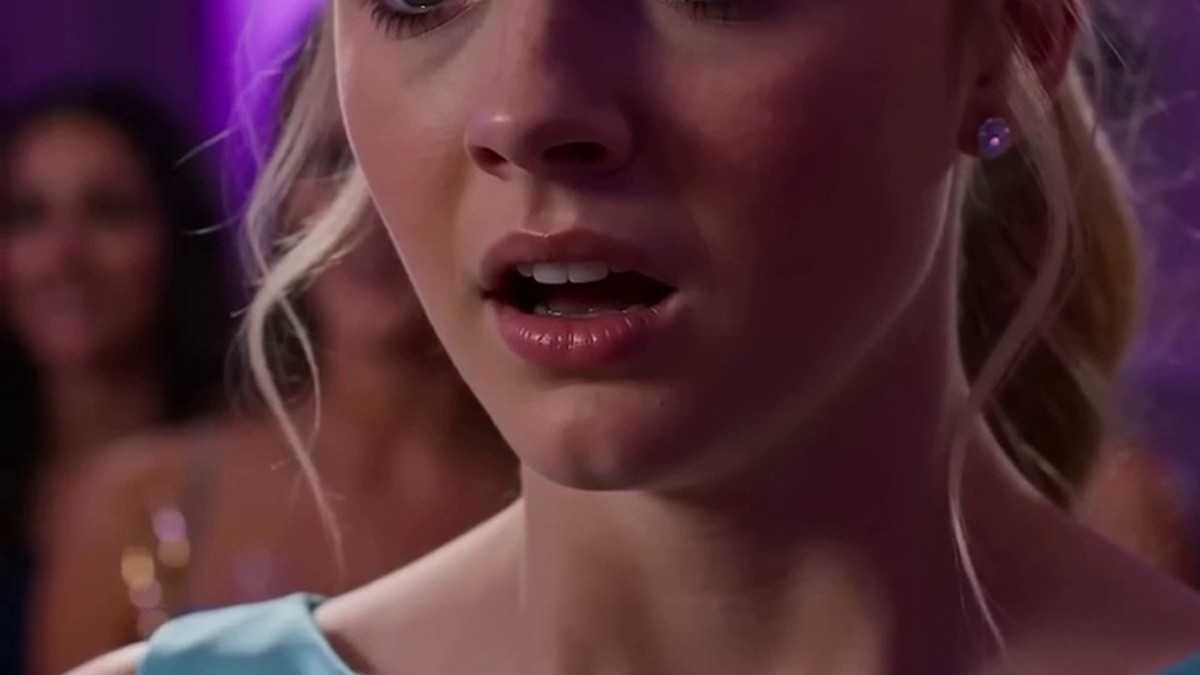
Then Madison appeared.
Madison fucking Keller. Cheer captain. Daddy’s-money blonde. She’d been grinding me down since middle school for reasons I never figured out. Maybe because I wore thrifted clothes. Maybe because I didn’t worship her. Maybe because some people just need someone to step on.
She sauntered over in this ice-blue dress that probably cost more than my grandma’s entire wardrobe. Her date—some quarterback from a private school—hovered behind her like a bodyguard.
Madison’s eyes slid from me to the wheelchair. She took in the lilac dress, the silk scarf, the way my grandma’s hand rested awkwardly in her lap.
And then she laughed. Loud enough to cut through the music.
“Oh my god.” She looked at her date. “Is this a prom or a Make-A-Wish Foundation event?”
The quarterback snorted.
Ice shot through my chest. Actual ice. My fingers locked around the handles of the wheelchair. I couldn’t breathe right.
Madison wasn’t done. She bent down so her face was level with my grandma’s, speaking slowly and loudly like you’d talk to a toddler.
“This is really sweet. Bringing your grandmother to prom. But maybe next time, you can pick a date who can actually, you know. Stand up.”
A couple of her friends laughed behind her. One of them—Jessica or Jennifer or whatever—looked uncomfortable and pretended to check her phone. But she didn’t say anything. Nobody did.
The room felt like it was closing in. The purple lights suddenly seemed sickly. The bass from the speakers thumped in my skull.
I was about to turn the chair around. Just spin it and push us straight out those double doors and never look back. I’d already started to when I felt a hand on my wrist.
Grandma’s left hand. Her good hand. Gripping me with surprising strength.
“Stop,” she said quietly.
Then she did something I’d never seen her do in the six years since the stroke. She shifted her weight. She reached across her body with her left arm and grabbed her right wrist—the paralyzed one—and dragged it forward into her lap. Then she pushed herself upright in the chair.
Not standing. She couldn’t stand. But sitting tall. Shoulders back. Chin up.
She turned her head toward the DJ booth at the front of the ballroom. There was a ramp at the side of the stage for accessibility. She looked at it. Then back at me.
“Push me up there.”
“Grandma—”
“Push me.”
I didn’t argue. My hands were shaking as I rolled her across the dance floor. Couples parted to let us through. The music was still playing but people were starting to notice. I heard whispers. A few more phones came out.
I got her up the ramp. The DJ—some twenty-something guy in a fedora—looked confused as I positioned her chair in the center of the small stage. Grandma gestured at his microphone.
“Can I borrow that, young man?”
He hesitated. Then handed it over.
The music cut off.
The room went dead silent. Two hundred teenagers in formalwear, their dates, chaperones by the punch bowl—all of them staring at this tiny woman in a wheelchair holding a microphone with her left hand.
She lifted it to her lips. Her voice came out scratchy at first, then steadied.
“Young lady. In the blue dress.”
Madison was still standing near the dessert table, frozen. Her date had backed up a step.
My grandma took a breath. And then she spoke five words that I will never, ever forget.
“I wish your grandmother could see you.”
The words hung in the air. Madison’s face went blank for a second. Then confusion. Then something like a crack forming in ice.
Grandma continued, her voice soft but carrying through every corner of that silent ballroom.
“Because mine taught me better than this.”
She set the microphone down in her lap with a click that echoed through the speakers. Then she looked at me and nodded.
I walked onto that stage, leaned down, and kissed her on the forehead. When I stood back up, I saw Madison. She hadn’t moved. Her jaw was slack. The quarterback had completely vanished—melted into the crowd like the coward he probably was.
The weirdest thing happened then. Someone started clapping. One person, somewhere by the back wall. Then another. Then ten more. And within maybe fifteen seconds, the entire ballroom was on their feet, applauding. Not for me. For the seventy-eight-year-old woman in the wheelchair who had just delivered the quietest verbal knockout punch I’ve ever witnessed.
The DJ didn’t know what to do, so he put on some slow song. An old one. Maybe Sinatra. I don’t remember.
What I remember is pushing my grandma’s chair back down the ramp and onto the dance floor. And then, because she couldn’t stand and I couldn’t lift her, I just knelt down beside the wheelchair. I put my hand on the armrest. She put her good hand over mine.
We swayed like that for the whole song.
Madison spent the rest of the night in a corner near the bathrooms, not talking to anyone. Her mascara was smudged. I didn’t feel bad. I didn’t feel good, either. I felt something else—something quiet and certain, like a door closing somewhere that didn’t need to be open anymore.
At 11:47, I wheeled Grandma back out to our dented Corolla in the parking lot. The Arizona night air was finally cool. The stars were out.
She looked up at them and smiled.
“Your mother would’ve loved that dress you wore,” she said.
I helped her into the passenger seat, folded the wheelchair into the trunk, and drove us home with the windows down.





