
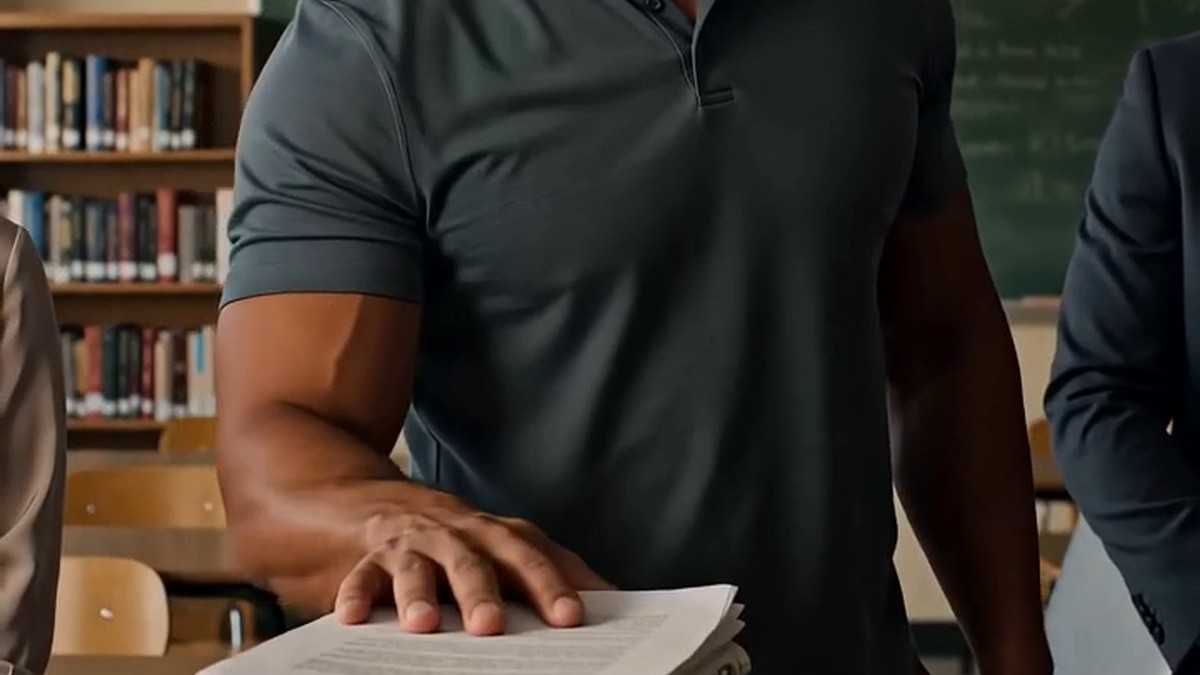
It was an ordinary Tuesday in late October, the kind of day when Walter Royce’s old radiator clanked and the fluorescent lights hummed just a little too loud. He was erasing a chalkboard full of limits and derivatives when the door opened without a knock. Three people stepped in—two men in sharp coats and a woman in a slate-gray dress, their faces both strange and hauntingly familiar. Royce froze, the eraser hovering.
The woman spoke first. “Mr. Royce, we’ve been looking for you.”
And suddenly, the smell of chalk and wet wool pulled him right back to the morning ten years earlier when he’d first set foot in the basement of Franklin High.
—
The principal, a rail‑thin woman named Mrs. Batiste, had handed him a class roster with the same enthusiasm you’d hand someone a live grenade. “Room 112,” she said. “We call it the Dungeon. I won’t sugarcoat it, Mr. Royce: those kids have run off three teachers in two years. Last month they set a toilet on fire. The position pays $34,500 with no health for the first year, and I’m supposed to tell you this is a great opportunity. It’s not. It’s a salvage job. You survive the year, I’ll write you a letter of recommendation to any school you want. Mess it up, and you’re on your own.”
Royce had nodded. He was twenty-eight then, fresh out of a tiny college upstate, and he’d grown up on a failing tobacco farm in Kentucky. He still spoke with the soft drawl of somebody who’d learned more from his mama’s one‑room schoolhouse than he ever did from any professor. “I appreciate the honesty, ma’am,” he said, and he meant it.
The Dungeon was a stale, windowless room at the end of a corridor that smelled permanently of weed killer and defeat. The thermostat was jammed at fifty-eight degrees, and the clock over the door had been stuck at 3:47 since the Ford administration. On his first day, Royce pushed the door open and a small, gray body tumbled onto the linoleum. A dead pigeon. Its neck was twisted, one glassy eye fixed on the ceiling. The class erupted—thirty‑three kids in sagging hoodies and scuffed Vans, howling with laughter, pounding desks, waiting for the new white‑boy teacher to lose his mind.
Royce didn’t flinch. He crouched, scooped the bird up with a spare piece of notebook paper, and carried it to the windowsill like he was handling a piece of fine china. Then he turned and faced the room.
“Pigeon,” he said quietly. “I kept tumblers when I was a kid. Birmingham rollers. My daddy paid twenty‑five dollars a pair, which was crazy money for us. They’d fly so high you’d lose ‘em against the sun, then fold their wings and drop like stones just for the joy of the fall. One afternoon a red‑tail got into the loft and killed my best hen. I was about your age. And, uh…” He paused, searching for the thread. “I guess I’m trying to say—math is a little like that. You open yourself up and sometimes it knocks you down. But it’s still worth doing.”
The laughter had died. A heavyset kid in the front row—Marcus, the crew leader, everybody called him—leaned forward. His eyes were sharp, calculating. He’d run numbers for a corner operation since he was twelve. “You serious? You had, like, a pigeon farm?”
“Farm’s a generous word,” Royce said. “More like a shack with ambition. But those birds taught me more about geometry than any textbook. Angle of ascent, wind resistance, parabolic arcs. What I mean is, math ain’t just numbers on a page. It’s the way things move. And you can use it.”
He wrote a single word on the board: Truth. “Every problem has a solution. Some are buried deep, but they’re there. The person who can find ‘em—that person isn’t just smart. That person is free.”
The Dungeon didn’t transform overnight. The next week somebody spray‑painted a curse word on his desk. Marcus got suspended for fighting in the lunchroom. But Royce kept showing up. He stayed after the final bell and worked equations on the board, not because he had to, but because he couldn’t stop. And slowly, three kids started staying behind too.
Marcus was the first. Royce caught him one afternoon sketching a gambling ring’s payout structure on a napkin—a raw, intuitive grasp of probability and expected value that would’ve made a statistician weep. “You ever hear of game theory, Marcus? John Nash, the Beautiful Mind fella? That’s what you’re doing. You’re building models in your head.”
“Man, I ain’t building nothin’,” Marcus said. “I’m just tryna survive.”
“Survival is the first application of mathematics,” Royce said. “But you can do more than survive. You can solve.”
After Marcus came Elise, a ghost at the back of the room. She never spoke, never raised her hand, just covered her notebooks with mesmerizing spirals and tessellations—intricate, unconscious works of art. Royce borrowed a book on fractal geometry from the public library and left it on her desk. When she opened it, her whole body went still. “These are my drawings,” she whispered.
“No,” Royce said. “Your drawings are these. You just didn’t have the words yet.”
And then there was Tyrone, a lineman‑sized boy who fixed transmissions at his uncle’s garage after school. His hands were always stained with grease, but his brain was pure lightning. He could factor polynomials in his head while rebuilding a carburetor. Terrified of looking soft, he hid his gift until Royce handed him a copy of *The Music of the Primes* and said, “Number theory. The deepest game in existence. You gonna let a little thing like fear keep you from playing?”
Tyrone didn’t.
They met in that basement room at four o’clock, every Tuesday and Thursday, for two years. Royce told them about Katherine Johnson and the Apollo trajectories, about Ramanujan and his dreams, about a young Évariste Galois scribbling the foundations of modern algebra the night before a duel. He taught them to see math not as a subject but as a rebellion—a way to crack open a world that had been closed to them from birth.
Marcus channeled his street logic into formal proofs. Elise’s drawings became the seed of a senior project on non‑linear patterns. Tyrone devoured college textbooks like they were comic books. By their senior year, the Dungeon class—the unteachable, untouchable 112—posted the highest math scores in the district.
Graduation day, Royce stood in the back of the auditorium in his one good jacket, watching the three of them cross the stage. Marcus shook the principal’s hand and looked straight at him, a small, fierce nod. Elise smiled for the first time Royce could remember. Tyrone got a standing ovation from the shop class. Royce clapped until his palms stung, and when the noise faded he realized his jaw was aching from the size of his grin.
—
Ten years collapsed into a heartbeat. Now, in the same chalky air, the three of them stood in front of him—Marcus in a charcoal suit with a laptop bag over his shoulder, Elise with a leather folio pressed to her chest, Tyrone in a collared shirt that strained just slightly at the seams.
Marcus spoke first, his voice deeper, steadier. “Mr. Royce, I want you to have something.” He pulled out a bound dissertation, thick as a brick. “I defended my PhD last month. Game theory. Applied probability. I create risk models for community reinvestment now—trying to put the numbers to work for the neighborhoods we came from. You told me once that every hustle is a system. I finally proved it.”
Royce took the document. He held it in both hands as if weighing it, then set it on the edge of his desk with a quiet thump.
Elise stepped up. “Fractal geometry. I publish under Elise Deveraux now—took my grandmother’s name—but the work started in this room. My dissertation’s on pattern emergence in chaotic systems. Basically, the math of how order gets born out of mess.” She laid her own bound thesis on top of Marcus’s. “You looked at a girl drawing in the margins and saw a future. I don’t know how you did that.”
Tyrone didn’t have a dissertation. He put a spiral‑bound manuscript, the pages curling at the corners, beside the other two books. “My master’s thesis. Elliptic curves. Got published in *The American Mathematical Monthly*. I’m still working on the PhD—takes longer when you’re holding down a day job in cybersecurity. I design encryption algorithms now. But I wanted you to have this anyway. The day you caught me working out a prime factorization on a scrap of transmission‑fluid filter? I was about to quit everything. I thought loving math meant I wasn’t a man. You gave me permission to be both.”
Royce looked down at the three documents—two hardbound dissertations and one dog‑eared manuscript—risen from the same sunless room where the school had dumped its hopeless cases. He took off his glasses, cleaned them on the tail of his shirt, then put them back on. They fogged anyway. He opened his mouth, closed it, and finally said, “Damn.” Then he shook his head and let out a short, ragged exhale that was almost a laugh.
Marcus didn’t let him stand there drowning. He pulled him into a hug, solid and real, and Elise wrapped her arms around them both, and then Tyrone’s big hand landed on Royce’s shoulder. For a long moment, the four of them just held each other in the quiet of the classroom, the radiator ticking, the world outside a distant hum.
Later, they sat at the very same scarred desks from a decade ago, drinking lukewarm coffee from a Thermos Royce kept in his satchel. Marcus laughed suddenly, a short bark. “You know that dead pigeon? On your first day? That was one of mine. I kept rollers on the roof of my building. I brought it in my backpack, thinking I’d scare you off like the rest.”
Royce nodded slowly. “I know.”
“How?”
“Saw you letting one go behind the dumpsters once. Put two and two together.”
Marcus stared at him. “You never said anything.”
“Didn’t see the point. You were a kid who thought the world was an enemy. I figured you’d tell me when you were ready.”
The afternoon light slanted through the high, grimy windows. They talked for another hour—about Tyrone’s night classes, Elise’s grandmother’s name, Marcus’s argument with his old crew. Nobody tried to sum things up. When at last they rose to leave, Royce walked them out to the parking lot. The three of them climbed into a rented Toyota. Before he shut the door, Marcus leaned out.
“Mr. Royce! You never did say what happened to your pigeons back in Kentucky. The rollers—did they ever come back?”
Royce stood on the cracked asphalt, the October wind pulling at his old tweed jacket. He just smiled, a slow, sun‑baked thing, and gave a small shrug. Then he waved them off.
He stood there until the car turned the corner and vanished. Then he walked back inside, picked up a fresh stick of Crayola chalk, and wrote *Tomorrow: L’Hôpital’s Rule* on the clean board. The chalk snapped in his hand with a sharp crack. He bent down, picked up the two pieces, and dropped them into the tray. The bell rang.





