
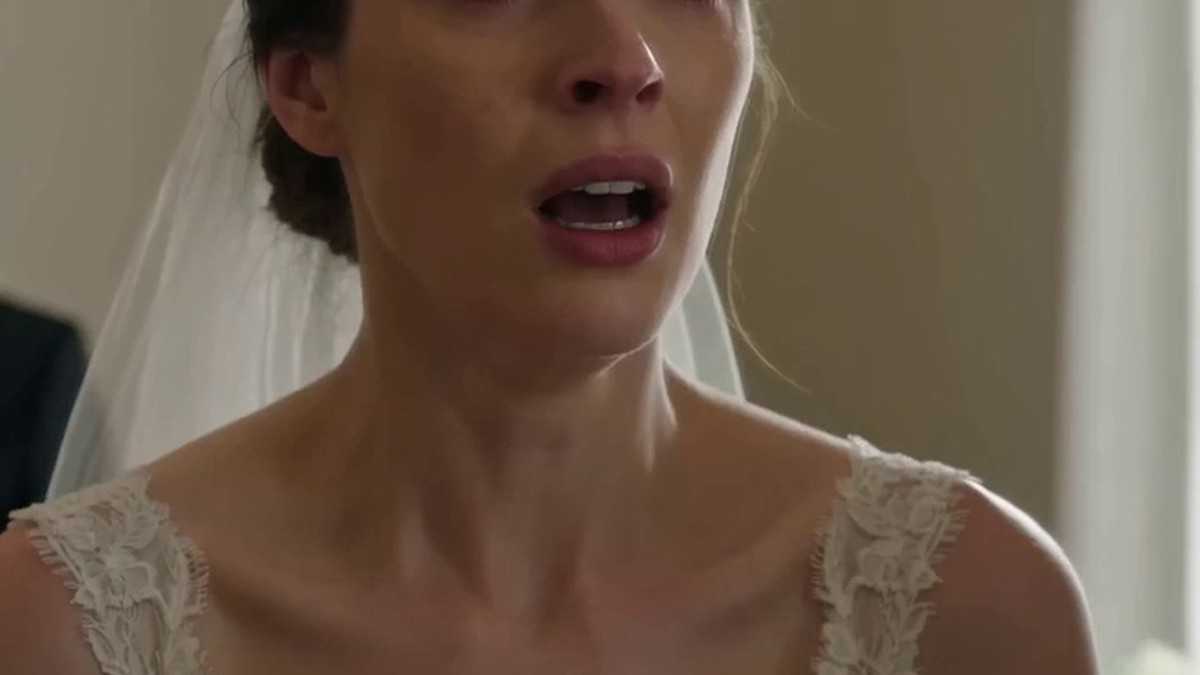
The catering was already paid for. So was the venue, the flowers, the dress that still hung in the closet with tags on. My dad had covered every last dime of the $27,400 celebration—120 guests, barely enough parking, a band I’d never heard and a cake from a bakery called Cake Crumbs that my mom insisted was “the one.” Invitations were out. Plane tickets booked. My mom had sobbed through my final fitting two weeks before.
Then my neuro-oncologist dropped a word that turned the whole room white.
Inoperable. Stage four glioblastoma.
I remember the cold of that exam room, the way I gripped James’s hand until my knuckles ached. I was sure he’d grip back harder. Instead, two days later, I walked into our kitchen and found him with a suitcase by the back door, eyes bloodshot, a half-empty bottle of Pepto-Bismol on the counter.
“I can’t,” he whispered.
At first I thought he meant the cancer. That he couldn’t handle the treatment road ahead. Then I got it. He couldn’t handle me.
He left before the wedding. Before I got too sick to be lovable, I guess. That was the moment I became a dying woman with a fully booked wedding and no groom.
I could have canceled it all. Crawled into a bed and waited. But I’d dreamed of my wedding since I was seven years old, and with the clock ticking down in my skull, I wasn’t about to give that up because some man bolted.
So I did the only thing that made sense to my scrambled, grief-stricken brain. At 2:13 a.m. I opened my laptop and searched “wedding stand-in actor Denver.” I scrolled past profiles with sharp headshots and rates like $500 for an hour. Absurd. Humiliating. I had nothing left to lose.
Then I saw him: listed under “budget performers” on a site called GigTown. No photo. Just a name—Leo. Rate: $175 for the whole day.
I sent him a long, rambling message explaining everything. The diagnosis. The runaway fiancé. The entire prepaid circus that was supposed to be the happiest day of my life. I figured he’d delete it or reply with a polite “no thank you.” Who signs up to play the husband of a terminal patient?
The next morning, I got a one-line email that made my thumb stop on the screen.
“I’ll do it… on ONE condition.”
I read it again, my thumbnail tracing the edge of my phone case. I braced for some weird actor demand. Instead:
“I won’t lie to your family. If they’re okay with the truth, I’ll walk you down the aisle.”
Something caught behind my ribs. Not relief—something closer to recognition, like finding a face you didn’t know you’d been looking for. I closed my eyes and exhaled through my nose, slow.
I told my parents at dinner that night. My mom cried into her wine glass. My dad stared at me for a long time, then asked quietly, “You sure about this?”
“Yes. I still want the wedding. Just—with a different man.”
He nodded after a few beats and reached for the roasted potatoes.
Leo showed up the next Tuesday at 6:30. No pretense, no charm offensive. Just a quiet guy in a thrifted blazer the color of old coffee, answered every question my parents threw his way with a steady, unhurried calm. When my mom asked why he’d agree to such a thing, he rubbed the back of his neck and said:
“I, uh… used to work in a hospice. Saw too many people alone. Your email just… I couldn’t delete it, I guess.” He paused. “My grandfather had the same cancer.”
Nobody said much after that. My dad poured him a whiskey. Leo got that look in his eye—no pity, just the quiet patience of a man who’d sat through overnight vigils.
The weeks before the wedding blurred. He came along for the cake tasting at Cake Crumbs, and I caught him with frosting on his upper lip, grinning like a kid who’d gotten away with something. He helped me pick the dinner menu, neither of us pretending it was normal. We practiced our first dance in my parents’ living room, me in slippers, him counting steps under his breath, and I stepped on his toes so much I started apologizing. “Worth it,” he said, and I laughed for the first time in weeks.
Then came the Thursday evening I’ll never forget.
We were on the back porch, wrapped in blankets against the October chill. Leo was trying to open a bottle of Coors Banquet with the edge of a lighter because he’d lost his opener; I watched him wrestle with it until the cap finally popped and skittered across the planks. He looked at me, a little embarrassed, and we both cracked up.
After a long silence, he said, “There was a woman on my floor named Margaret. No family. Nobody to call. I sat with her the night she died, holding a plastic spoon she kept asking for, like it was important. Promised myself after that I’d never walk away from someone who needed me.” He took a sip of his beer, not looking at me. “When I read your email, I thought, here’s a woman who sounds incredible, and she’s being left behind. Maybe I could be the guy who shows up for once.”
I didn’t think. I reached over and laid my hand on his. His fingers stilled. He turned his palm up and held on—not tightly, just there. We sat like that until the porch light flickered on and my mom’s voice called us inside. Something had shifted. I didn’t have a name for it, just a quiet warmth that stayed with me as I fell asleep that night, still feeling the ghost of his thumb against my knuckles.
Fifteen minutes before the ceremony, I was in the bridal room adjusting my veil when the door banged open. James. Hair disheveled, face wrecked, clutching a little velvet box like it could undo everything. His cologne filled the room—the same one he’d worn on our first date, hitting me with a wave of nausea.
“Please, Emily. I was scared. I love you. I never should’ve run.”
I looked him straight in the eyes for what felt like a full minute. My hands were shaking. “You left when I needed you most. There is no coming back from that.”
He tried to say something else, but then Leo stepped into the doorway behind him. He didn’t say a word. He just walked over and took my hand, his palm warm and dry. My shoulders dropped so suddenly I almost swayed.
James stammered an apology and backed out. I didn’t watch him go.
I walked down the aisle on my dad’s arm, the organ—my mom’s pick, “Jesu, Joy of Man’s Desiring”—swelling, and when I reached Leo at the altar, he leaned in and whispered, “You made it. I’m proud of you.”
The ceremony was short. When Leo spoke his vows, he didn’t stick to a script.
“I came here to give her the wedding she wanted,” he said, voice rough but clear. “But somewhere along the way, I started looking forward to her smile every morning. Emily, I’m not going anywhere.”
In the front pew, my brother stared at the ceiling, blinking hard, and my aunt’s mascara left a black streak on her cheek. I kept my eyes on Leo.
After the reception—cake popped out of his nose this time, which made the photographer snort—he didn’t leave. He drove me to my first chemo session the following Monday, his Honda Civic smelling faintly of coffee and old gym socks. When the nausea hit at three in the morning and I barely made it to the toilet, he held my hair back with one hand and kept the other on my shoulder, steady as a rock. As I rinsed my mouth, he muttered, “So much for my acting career—I thought this was just a hand-holding gig.” I laughed and cried at the same time, and he just handed me a towel.
He read to me on the bad days, his voice pulling me through the fog, and on the good days we danced again in the kitchen, barefoot, a little slower.
I’m writing this from a hospice bed in Denver, the afternoon sun slanting through the blinds. Outside the window, two kids on skateboards are laughing and scraping the pavement. The IV pump clicks every few seconds, a sound I’ve learned to count. Leo is in the chair beside me, half-asleep, a half-opened can of Sprite going flat on the tray table, one hand draped over the bed rail. He shifts and mumbles something about a dog—his childhood lab, maybe. His fingers twitch against mine. Then they tighten, a small, unconscious squeeze, and he settles back into a deeper sleep.
I don’t move my hand. I don’t think I could if I tried.





