
Nate Holloway was haggling over a jar of honey when his seven-year-old tugged his sleeve so hard his coffee sloshed onto his wrist.
“Dad. That kid has your eyes.”
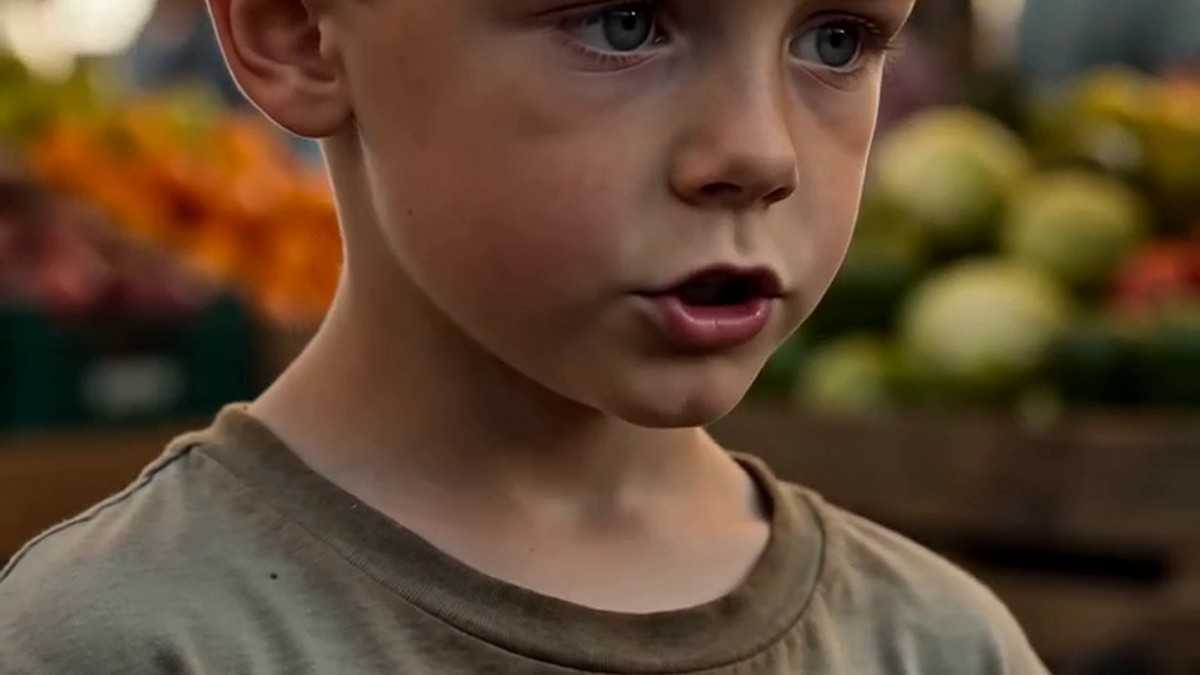
He looked down at Sophie, then followed her gaze past the crates of kale and the guitar player to the edge of the market, where a boy sat alone on a low brick wall. The kid was maybe eight, skinny, with dirty-blond hair that hadn’t seen scissors in months. He wore a backpack that looked like it weighed more than he did.
Nate’s first thought was that Sophie needed glasses. His second thought never arrived. The boy lifted his head and stared right back at him.
The eyes were a washed-out, almost transparent blue — the kind of blue you only see in high-altitude lakes and on Nate’s own face in the mirror. Sophie had them too. The Holloway eyes, his mother used to call them, because they skipped a generation everywhere except in him.
Nate set the honey down. His palm was suddenly damp.
He walked over, Sophie trotting beside him. The boy didn’t flinch. Up close, the resemblance was a punch to the sternum. Same chin with the tiny cleft. Same ears that stuck out just slightly. Same way of tilting his head when he was sizing someone up.
“Hey, buddy,” Nate said. “You lost?”
“No.” The boy’s voice was quiet but steady. He shrugged off the backpack and unzipped it with the careful movements of someone who had been taking care of himself for a long time. From inside, he pulled out a Ziploc bag with a single sheet of yellow legal paper wrapped around something flat.
He handed the bag to Nate.
The paper had one line written in loopy cursive: *If you find the man in this picture, tell him he’s your father.*
Nate’s fingers felt like they belonged to someone else as he opened the bag and slid out a Polaroid.
The photo was faded, curved with age, but the image was unmistakable: a younger Nate, twenty-two or twenty-three, standing in a hospital room with a surgical mask pulled down under his chin. He was holding a newborn swaddled in a blanket with tiny blue stripes. His eyes in the photo were red-rimmed, but he was grinning like a lottery winner.
Nate knew the blanket. He still had it folded in a box in the garage.
That photo had been taken seven years ago. An hour after the twin birth. An hour before the doctor had walked in and explained that the second baby — a boy — had stopped breathing.
“There were complications,” the doctor had said, his scrubs still flecked with something dark. “We did everything we could.”
Nate had held his daughter, Sophie, while his wife Lauren had screamed into a pillow. He’d believed them. Everyone had believed them. The funeral home had given them a tiny white casket at a discount because nobody should have to pay full price for a baby’s funeral.
Now the boy from the brick wall was standing in front of him, breathing, blinking those impossible blue eyes.
“What’s your name?” Nate managed.
“Leo.”
“Leo, this photo… where’s your mom?”
The boy looked down at his sneakers — duct-taped across one toe. “She’s sick. In the hospital. She told me to take the bus here and wait.” He paused. “She said you’d be here on Saturdays.”
Nate crouched so he was eye level with the boy. The market noise faded into a hum. “How long has she been telling you about me?”
“Since I was little. She showed me the picture every night before bed. Said it was my dad. Said you didn’t know I was alive because something bad happened at the hospital.” Leo’s lower lip quivered for half a second before he pressed his mouth into a hard line. “She said if I couldn’t find you, to go to the police and give them her name. Carla Keene.”
Carla Keene.
The name hit Nate like a freight train with no lights on. Carla had been one of the nurses on the maternity floor. He remembered her clearly — tall, quiet, always wearing those clogs with little cartoon cats on them. She’d been kind to Lauren during the long labor. She’d been the one who took the Polaroid, actually. She’d said, “You’ll want to remember this day.”
He’d never seen her again after that shift.
Sophie, who had been listening with her arms crossed, stepped forward. “Are you my brother?”
Leo looked at her, then at Nate. Nobody spoke.
Nate’s phone buzzed. It was his sister, probably reminding him about Sunday dinner. He ignored it. He stood up, pulled out his phone, and instead called the hospital where Lauren had given birth. The line trilled seven times before a receptionist picked up. He asked for records from seven years ago, regarding a Carla Keene.
The receptionist put him on hold for nearly ten minutes. When she came back, her voice had changed. “Sir, I’m not authorized to discuss personnel matters, but I can confirm that Ms. Keene voluntarily resigned from her position shortly after the incident you’re referring to. Her file has been flagged.”
“Flagged for what?”
“I… I can’t say. I’m sorry.” She hung up.
Nate stared at the phone. Sophie was already showing Leo the ladybug she’d caught on a blade of grass. Leo was half-smiling for the first time, his guard dropping by inches.
Nate made another call — this time to his brother-in-law, a detective with Portland PD. He gave him the bare facts, voice low so the kids wouldn’t hear. His brother-in-law was silent for a long moment, then said, “Give me an hour.”
They waited at a picnic table near the crepe stand. Nate bought Leo a Nutella crepe and watched him eat it like he hadn’t had breakfast in a week. Sophie chattered about her fish tank. Leo answered in short sentences. He told them he lived in a small apartment near the city, that Carla had worked night shifts cleaning offices, that she’d been coughing for two months before she finally went to the ER last Tuesday.
“They put tubes in her throat,” Leo said, wiping chocolate off his chin. “She can’t talk anymore. But she wrote me a bunch of notes. That one with the picture was the first one.”
Nate’s jaw tightened. He thought about Carla, alone in a hospital bed, writing frantic instructions for her son to find the stranger she’d stolen him from. It was monstrous. It was also, somehow, a kind of love — warped and desperate and impossible to untangle.
His brother-in-law called back at 3:17 p.m.
“Nate, you need to sit down.”
“I’m sitting.”
“The hospital had an internal investigation two days after your son’s death. An orderly noticed discrepancies in the crash cart inventory and the security footage in the neonatal wing. The tape showed Carla entering the NICU at 3:42 a.m. with an infant carrier under her coat. She left at 3:58 a.m. with the carrier covered by a blanket. They never caught her because she’d already called in sick for the next three days and cleared out her locker. The hospital buried it to avoid a lawsuit.”
Nate’s vision blurred. The world felt like a radio dial stuck between stations, nothing but static.
“Where is she now?” he asked.
“Providence St. Vincent. She’s in the ICU, stage four lung cancer. They’re saying days, maybe weeks.” He paused. “Nate, there’s more. When the baby disappeared, the official record listed the cause of death as stillbirth. But the original file from the delivery room — the one the hospital tried to delete — shows the boy was born with an APGAR score of nine. Healthy. Crying. They handed him to you, Nate. You held him. There’s a notation from a nurse that says, ‘Father bonded with infant male twin for approximately 25 minutes.’ The cover-up started after Carla took him.”
Nate looked over at Leo. The boy had Sophie’s ladybug perched on his thumb and was watching it clean its antennae with an expression of total wonder.
For seven years, Nate had mourned a child he’d held, heard cry, and then been told had turned cold. For seven years, he’d visited a grave with no body inside it and watched his marriage disintegrate under the weight of a loss that wasn’t a loss at all.
And now that boy was sitting three feet away, ladybug on his finger, wearing duct-taped shoes.
That evening, Nate drove to the hospital with Leo and Sophie in the backseat, eating drive-thru chicken nuggets. He’d called Lauren on the way and told her everything. She’d gone silent for so long he thought the call had dropped. Then she’d said, “I’ll meet you there,” in a voice he hadn’t heard since the day they’d signed the divorce papers.
The ICU had a small family waiting room with plastic chairs and a coffee machine that made black water. A social worker met them there — a woman named Deirdre who had already spoken with Carla’s doctors. She explained that Carla had left a written statement with her attorney, confessing to the kidnapping and detailing how she had raised Leo under a false name, using forged documents. She’d never married, never had other children. She’d told Leo the truth about his father when she realized she was dying because she was terrified he’d end up in foster care.
“She’s asking to see you,” Deirdre said to Nate. “And she’s asking to see the boy one last time.”
Nate wanted to be angry. He was angry, somewhere deep down, beneath the shock and the relief and the impossible strangeness of the day. But when he walked into that hospital room and saw Carla — jaundiced, skeletal, tubes running out of her arms and mouth — the anger didn’t come out the way he expected. It came out as silence.
Carla couldn’t speak, but her eyes were wet and wide. She held up a small whiteboard with shaky handwriting: *I’m sorry. I couldn’t have children. I lost my son at 22 weeks and I saw your baby and I just… I took him. I know sorry is nothing.*
Nate read it twice. Then he did something he hadn’t planned: he pulled up a chair and sat beside her bed.
“He’s smart,” Nate said, his voice cracking. “He kept that photo safe for years. He took two buses by himself to find me. You obviously… you raised him well, in spite of everything.”
Carla’s hand shook as she wrote a single word: *I know.*
Nate nodded slowly. There would be lawyers, police statements, a massive legal storm to untangle. But right now, there was just a dying woman who had done the unforgivable and still, somehow, managed to give a lost little boy seven years of bedtime stories and duct-taped shoes that fit.
He let Leo come in. The boy walked to Carla’s bedside and took her hand like he’d done it a thousand times. She wrote something on the whiteboard that made him cry — Nate didn’t see what it said — and then Leo pressed his face into her shoulder and stayed there until a nurse gently told them visiting hours were over.
Lauren arrived at the hospital just after nine. She looked ten years older and ten years younger at the same time. When she saw Leo in the hallway, she stopped walking. Her hand went to her mouth.
“Oh,” she breathed. “He looks just like you.”
Leo looked up at the stranger woman, then at Nate, then back at her.
Sophie, who had been half-asleep in a plastic chair, perked up and said, “Mom, guess what! I have a brother now. His name is Leo and he likes ladybugs.”
Lauren’s face crumpled. She crossed the hallway in three steps and went down on her knees in front of Leo. She didn’t hug him — she didn’t want to scare him — but she held out her hand, and after a moment, Leo shook it.
“I thought you were gone,” she whispered. “We both did.”
Leo looked at his father. Nate nodded, tears finally spilling over. “We’re going to figure this out, okay? All of it. One step at a time.”
Leo thought about it. Then he reached into his backpack and pulled out a crumpled grocery store receipt and a stub of pencil. He wrote something and handed it to Lauren.
*Can I still visit my mom? The one who’s sick.*
Lauren read it. She looked at Nate. He looked at the boy.
Nate knelt down. “Yeah. We’ll bring you to see her as long as she’s here. I give you my word.”
Leo blinked, processing that, then simply nodded. He put the pencil back into his backpack, zipped it up, and leaned against Sophie, who immediately started telling him about the proper way to feed a goldfish.
Nate stayed on the floor of the hospital hallway for a long moment, the Polaroid still in his pocket. The ghost of a seven-year-old lie had finally let go of his chest, and in its place was something raw and jagged and entirely alive.





