
The first night I heard the howl, I was sitting on the porch of my grandmother’s old mountain cabin with a lukewarm beer and a head full of anger. Seven o’clock, sun blazing orange behind the ridge, and this raw, mournful sound cut through the pines like a siren. A scrawny rust-colored dog sat just beyond the split-rail fence, nose pointed at the sky, crying as if it was counting out something only it could hear.
By the third evening, Gus from the next property over banged on my door with his walking stick. “You gonna do something about that animal, or do I have to call animal control? It’s like clockwork—8 p.m. sharp every night.”
I told him I’d handle it. Truth was, I’d already tried. I put out bowls of water and leftover meatloaf. The dog never touched them. It would just stare at the cabin with unnaturally bright eyes, then vanish into the treeline the second I stood up. Too skinny to survive another winter up here—I could count its ribs from twenty feet away.
I’d come to the cabin to escape. My grandmother Rosemary had passed two years earlier and left me this little two-room place tucked in the foothills west of Boulder, Colorado. At the time, it felt like the only thing my ex-husband Rick couldn’t bulldoze his way into. He’d already pushed to list it so we could “liquidate assets” and move on, as if a decade of marriage and a house my grandma had built with her own hands were just numbers on a spreadsheet.
“Emma, you’re being irrational,” he’d said on my voicemail that morning. “Just sign the papers and we both get a check. My lawyer says we’re looking at twenty-three thousand after fees, tax-free. That’s a fresh start.”
I deleted it without listening to the end. I had no cell signal half the time anyway. The cabin had one woodstove, a creaky loft, and a roof that leaked only when the wind blew from the east. It was mine, and I wasn’t giving it up.
That Saturday, I hauled myself up to the loft intending to clear out the decades of junk. Rosemary had stored her life in cardboard boxes and a cedar chest: hand-stitched quilts, yellowed seed packets, stacks of photo albums. I spent the morning flipping through a brittle wedding album from the 1950s, tracing my grandmother’s handwriting on the back of a snapshot. Nothing. Just pictures of strangers with familiar cheekbones. The afternoon sun threw long shadows across the floorboards, and the heat became a headache. I shoved the albums back on the shelf and climbed down, telling myself I’d finish later.
The howl came again that night, right at eight. I stood at the kitchen window and watched the dog, still as stone, eyes fixed on the house. There was something unsettling in the way it seemed to be waiting, not begging. Like it was keeping an appointment.
On Tuesday, I forced myself back into the loft. My divorce had left me with too much empty time, and the cabin’s silence only amplified the mess in my head. I pulled out the wedding album again and this time, when I ran my fingers across the back cover, I felt a slight bulge beneath the heavy paper. I peeled the endpaper away from the board. A manila envelope had been glued flat inside, hidden for God knows how long. *For Rosemary—personal*, it said in shaky cursive.
My hands went still. I carried the envelope down to the kitchen table and sat for a long minute before I slid the letter out. Onion-skin paper, the kind my grandpa John used to type his sermons on.
*Rosie, if you’re reading this, I’m already gone. I need you to know the truth. Your mother and I told you the baby died, but that was a lie. Your sister Darlene was born healthy and I sent her to live with my cousin in Ward because I was too damn proud to face the church. I’ve been sending money all these years, but I never had the guts to bring her home. She’s still up there—or her people are. If you want to find her, ask for the Harper place on Left Hand Canyon. Forgive me. – Dad*
I read it three times, swallowing hard. My grandmother had a sister. Everyone in the family—my mom, my aunts—had described Rosemary as an only child. I grabbed my keys and walked down the driveway until my phone found one bar.
“Mom, it’s me.” I used my calm voice, the one I’d learned during the divorce. “Did Grandma ever mention a sister named Darlene?”
Static on the line. Then, “Where did you hear that name?”
“I found a letter Grandpa John wrote.”
“Emma, your grandmother was an only child. I never heard of any sister.”
“The letter says he hid her in Ward. Mom, you’re telling me you never saw a birth certificate, a photograph, anything?”
There was a long pause, the kind that means a door is about to open. “I was sixteen. I found a certificate—name Darlene Harper—in a box of old tax returns. Your grandmother said the girl died in infancy and I was never to mention it again.” Her voice tightened. “I didn’t. I thought it was just another family ghost.”
“It wasn’t a ghost. She lived.”
“Sounds like him. He was a proud man, Emma. What are you going to do?”
I looked out the window. The dog was already there, copper coat catching the last light, watching me. A memory clicked: Rosemary used to put a bowl of scraps at the fence every evening around eight for a stray that wandered down from the canyon. She’d done it for years until she got too sick. I’d forgotten until now. The dog wasn’t howling—it was waiting for a woman who no longer came.
“I’m going to find the Harper place,” I said, and hung up.
I pulled on a jacket and grabbed a flashlight. The moment I stepped outside, the dog turned and loped away along the shoulder of the gravel road, stopping every thirty yards to look back at me, ears perked. A two-hour walk, the kind that makes your calves burn and your mind quiet. Past the cluster of old mining shacks that passes for a town of Ward, up a narrow drive I’d never noticed before, until we reached a sagging Victorian with an overgrown yard. A 1998 Ford camper sat in the weeds, and behind the main house, a low cinder-block outbuilding that might once have been a tool shed. The dog slipped through a gap in the fence and let out a single sharp bark.
A young woman’s voice came from the shed—thin, cautious. “Rusty? Is someone there?”
I pushed open the gate. “Hello? My name is Emma. I’m Rosemary Harper’s granddaughter. I think we’re related.”
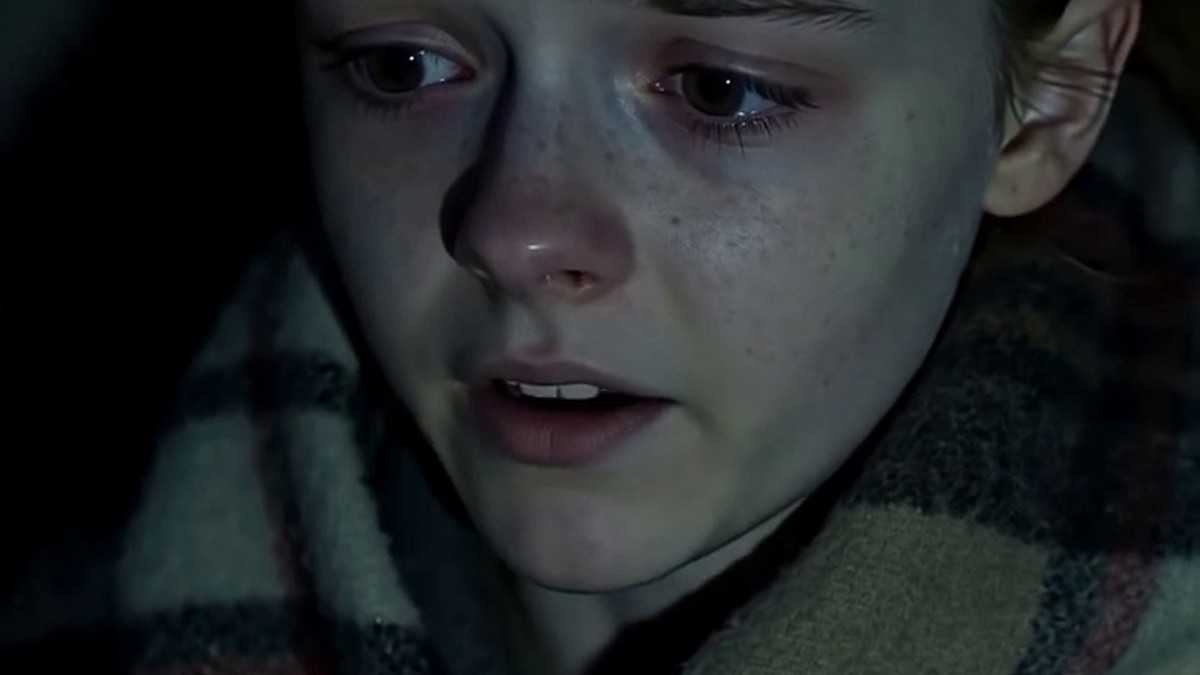
The door cracked open. A girl in her early twenties, pale and too thin, stood wrapped in an old flannel blanket. Dark hair pulled back with a rubber band. She had the same wide-set hazel eyes as my grandmother’s photographs.
“Rosemary,” she repeated. “My mom talked about her—said she was her aunt, but they never met.”
“Your mom was Darlene’s daughter?”
She nodded. “I’m Lily. Darlene died ten years ago. Cancer. I’ve been staying here with my mom’s cousin Stan and his wife. They said the main house was too full.” She looked down at the dirt floor of the shed. “I’m just waiting till I save enough for my own place. I’ve got four hundred dollars in a coffee can, but rent in Boulder’s insane.”
I dug my keys into my palm so hard a ridge left a mark. “How long?”
“Two years. I was in a shelter before that, but Stan told me family should stick together.”
The dog wagged his patchy tail and pressed his nose into Lily’s palm.
“Lily, I live in a cabin just down the canyon. It belonged to Rosemary, your mother’s aunt. It’s got an empty loft, a woodstove that works too well, and a porch that faces the sunset. You and Rusty are coming with me tonight.”
She blinked, glassy-eyed, and pulled the blanket tighter around her shoulders. “You don’t know me. Stan said if I left there’d be no coming back.”
“Stan can call the sheriff if he wants. You’ve been sleeping in a shed, and I’ve got a letter from a grandfather who shattered this family because he was ashamed.” I pulled the envelope from my pocket and held it out. Lily took it with chapped fingers and read silently, her mouth a thin line.
Rusty whined once, low in his throat.
“I can’t just—” Her voice cracked.
I put my key in her hand. “You can. This dog has been coming down to my fence every evening for two weeks, looking for someone. He found me.”
She packed a trash bag with her few belongings, and we walked back down the canyon in the dark, Rusty trotting ahead with his tail high for the first time. Behind us, the porch light at Stan’s house flicked on and off, but no one came outside.
By the time we reached the cabin, it was nearly midnight. I heated up tomato soup on the woodstove and Lily ate three bowls without taking a breath. Rusty curled up on a braided rug near the hearth and fell asleep with his paws twitching.
The next morning, my phone buzzed. Rick’s voicemail, forwarded through the patchy signal: “Emma, my lawyer filed the motion. A forced sale is on the table. This is your last chance to be reasonable—call me.”
I called him back from the driveway. “The property isn’t for sale, Rick. It’s my home. And it’s now a family home.”
He laughed, the brittle kind. “What family? You’re living up there with ghosts.”
“My cousin lives with me now. Her name’s Lily. She’s great.” I hung up and went inside to make coffee.
That afternoon I borrowed Gus’s landline and called a legal aid clinic in Boulder. A tired-sounding attorney walked me through the facts: the cabin was separate property inherited during the marriage, but the court could still order a partition sale if one spouse couldn’t afford to buy out the other’s marital interest. Rick had tried to chip away at my sole ownership by claiming we’d used joint funds for improvements, but the improvements were a new porch beam I’d paid for from my own account. The lawyer asked for an appraisal. Gus knew a retired realtor who’d done drive-by assessments for folks in the canyon. His number: $122,000.
I called Rick two days later. “The house appraised at one twenty-two. I’ll wire you thirty thousand tomorrow—my half of the equity from the divorce settlement, dipped into a little savings. You sign a quitclaim and walk away with more than your ‘check’ would’ve netted after the court fees. Deal?”
Rick was quiet so long I checked to see if the call had dropped. “You’re serious.”
“I’m tired of fighting. Take the money, Rick.”
“I’ll have my lawyer draw up the papers,” he said, and I heard something in his voice I hadn’t heard in years: a man realizing he’d already lost.
Over the next few weeks, Lily transformed the place. Turns out she’d been working morning shifts at a bakery on Pearl Street in Boulder before she lost her housing, and she could bake a huckleberry pie that made Gus next door cry real tears. She sold them for eleven dollars each, and by the end of the month, she’d bought a gallon of exterior stain for the porch. She fixed the leak in the roof with flashing tape and a YouTube video, and she started a vegetable patch where the old chicken coop used to be. The first time she laughed—not a polite chuckle, but a laugh that doubled her over—was when Rusty chased a deer fly and crashed headfirst into the woodpile. She straightened up wheezing, sap-dusted and grinning.
In the evenings, I’d find her on the porch with a tape measure, figuring the fence posts she planned to reset before winter. Rusty, finally filling out, would lie between us with his head on his paws, coat shining in the low light. The clock on the kitchen wall chimed eight, and the dog let out a soft, contented huff. That was all.
Three weeks in, Lily set a fresh pie on the table and said, “Do you think our grandmothers would’ve liked each other?”
I pulled Grandpa John’s letter from the drawer where I’d been keeping it. I held it over the woodstove until the edge caught, then laid it on the coals. The paper curled and blackened.
“Rosemary made quilts for strangers, and Darlene named her dog Rusty,” I said. “I think they would’ve gotten along just fine.”
The dog thumped his tail once against the rug. Outside, Gus yelled something friendly from his porch, and Lily poured two cups of coffee, the steam rising into the pine-scented air.





