The organist hit a sour note and my heels stopped every murmur cold. I stepped through the doors of St. Anne’s exactly twelve minutes before my ex-husband was supposed to kiss his seventy-year-old mother and present her to three hundred guests as his blushing new bride.
No bouquet. No veil. Just a small black velvet box tied with a silver ribbon, tucked against my hip like a grenade.
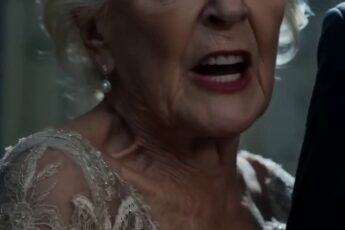
My ex-mother-in-law, Lorraine Beaumont, saw me first. She was standing near the altar in a cloud of ivory lace, her silver hair swept up like a Victorian ghost. For a split second she looked almost giddy—until our eyes met. The smile bled straight off her face, as if someone had cut a string. She whispered something sharp to Tucker, my ex, who was busy straightening his bow tie with his back to the congregation. He didn’t see me yet.
Aunt Beverly fumbled her program. Cousin Mike knocked over a kneeling rail. I kept walking, my pace slow and deliberate, the marble floor throwing echoes up into the vaulted ceiling like warning bells.
I’d rehearsed this moment in my head for three months. The box held everything: a DNA test, a three-page addendum to the Whitfield Family Trust, and a very recent court order. I hadn’t come to stop a wedding. I’d come to burn a house down with the truth.
—
Two and a half years earlier, I’d filed for divorce from Tucker Beaumont after I found out he’d drained our joint savings to fund his “import business,” which turned out to be a storage unit full of counterfeit handbags. The marriage was a dumpster fire. The divorce was worse. Tucker swore up and down I’d walk away with nothing, because his great-uncle Josiah Whitfield had built a textile fortune in the 1960s, and the family trust had a famously twisted rule: the bulk of the estate went to the first Whitfield male heir who married and stayed married for a full decade. Tucker was the only male heir under fifty. If he made it to ten years, he and his wife would inherit roughly four million dollars, plus the old Whitfield estate on Tybee Island.
We split at eight years and seven months. Tucker was livid. At the settlement hearing, he actually laughed and told my lawyer that I’d just “priced myself out of the jackpot.” I believed him. Everyone did. Lorraine had the whole family convinced the money was gone to her baby boy the moment I signed the papers.
What nobody counted on was Great-Uncle Josiah’s pettiness from beyond the grave.
Six months after the divorce was finalized, a retired accountant from Savannah contacted me out of the blue. He’d been the trustee’s bookkeeper for forty years and had a guilty conscience. He sent me a PDF of an obscure codicil to the original 1972 trust document—something Josiah had penciled into the margins during a fight with his own sister. The codicil stated that if a Whitfield heir’s marriage ended due to fraud, abandonment, or “moral turpitude” on the part of said heir, the spousal share defaulted to the ex-spouse. Not the family. Not the next cousin. The ex-wife. It even specified that she retained full rights even after divorce, provided she never remarried and could prove the heir’s misconduct.
Tucker’s counterfeiting arrest three months into our marriage—an arrest he’d hidden from me, but which I’d discovered after the divorce—qualified as fraud and moral turpitude on every level.
So I lawyered up in secret. I hired a forensic genealogist to dig through the Whitfield family tree, mostly because Lorraine started doing strange things: she changed her legal name from Lorraine Beaumont to Rainey Whitfield-Cole, got a new driver’s license that knocked twenty-two years off her birthdate, and began showing up in Tucker’s Instagram stories with captions like “dinner with my favorite person” and heart emojis. At first I thought it was just her being disturbing, which was par for the course. Then my investigator found a marriage license application filed in Chattahoochee County. The groom: Tucker James Beaumont. The bride: Rainey Whitfield-Cole, age forty-eight. Tucker’s mother was actually seventy, but with enough makeup and a fake ID, she could maybe pass for a hard-lived forty-eight in dim church lighting.
They were going to marry each other. Mother and son. They were going to stand in front of a priest, swear vows, and then walk straight to the probate court to claim the trust as “husband and wife,” banking on nobody looking too closely at the birth certificates.
The forensic genealogist nearly had a coronary. When I told my lawyer, he sat completely still for eleven seconds and then said, “I’m going to need you to say that again so I know I’m not having a stroke.”
The DNA test that proved Lorraine was Tucker’s biological mother came back in late July. The amended trust ruling came through at 9:43 a.m. on the morning of their wedding.
—
I slid into the third pew on the groom’s side. Tucker finally turned around. His face cycled through confusion, annoyance, and then a slow, creeping panic when he recognized me.
“Cora. What the hell are you—”
“Sit down, Tucker. You’re going to want to hear this.” My voice was quieter than I expected. The whole church could hear a pin drop now.
Lorraine clutched her bouquet so hard the stems snapped. She didn’t move.
I opened the box. I lifted out the first paper—the DNA report—and held it up so the front rows could see the lab letterhead. “This is a certified genetic test confirming that Lorraine Beaumont, also known as ‘Rainey Whitfield-Cole,’ is the biological mother of Tucker Beaumont. Which, by the way, makes this proposed marriage a third-degree felony in the state of Georgia.”
A gasp rolled through the pews. Somebody’s phone crashed to the floor.
Tucker took a step toward me, face pale. “That’s forged.”
“Sure. And this too, I guess.” I pulled out the codicil. “This is the part of Great-Uncle Josiah’s trust that says if a male heir’s marriage ends because he’s a lying felon, his ex-wife inherits everything. I have a court order from Savannah, stamped this morning, confirming that all assets—including the Whitfield estate, the investment portfolio, and the four-million-dollar principal—are now legally mine.”
Lorraine made a sound I’ve never heard a human make before, a kind of ragged wheeze. Her carefully powdered composure shattered. She grabbed Tucker’s arm and hissed, “You told me she signed the waiver. You told me she couldn’t touch it!”
“She *couldn’t*!” Tucker’s voice cracked. He looked at the priest, who was backing toward the sacristy with wide eyes, then back at me. “Cora, think about this. That money belonged to my family for generations.”
“It belonged to your great-uncle, who apparently hated people who traffic fake Gucci bags and try to marry their own mothers.” I handed a copy of the court order to his Aunt Beverly, who snatched it and began reading aloud in a horrified whisper. “I won’t press charges for the fraud—today at least. But if either of you comes within five hundred feet of me or the Tybee Island property, I will.”
I closed the box. The silver ribbon fluttered loose and drifted to the floor. Nobody moved to pick it up.
Tucker’s eyes went wet and frantic. “There’s still time to fix this. We can, we could—”
“Fix it? Tucker, your mother is standing next to you in a wedding dress. There’s no fixing it.” I turned on my heel and walked back up the aisle, past the blown-out candles and the flower arrangements that had cost someone eight thousand dollars according to the receipt I’d found in his glove box.
Behind me, Lorraine started wailing. Somebody’s elderly uncle was demanding to know what “moral turpitude” meant. The organist, God bless her, accidentally leaned on the pedals and produced a deep, booming chord that echoed through the chapel like the closing note of a horror movie.
I didn’t smile. I didn’t look back. The heavy oak doors swung shut behind me, and the last thing I heard was Tucker shouting my name with a choke in his throat and the priest muttering that he was calling his bishop.
Outside, the March air smelled like salt and azaleas. I got into my car, set the velvet box on the passenger seat, and drove toward Tybee Island. The sun was setting over the marsh, and the house Great-Uncle Josiah had built with his own hands was waiting for me at the end of a long, unlit road.
I rolled down the window and let the wind hit my face. For the first time in years, I didn’t feel like I was running from something.
I was arriving.