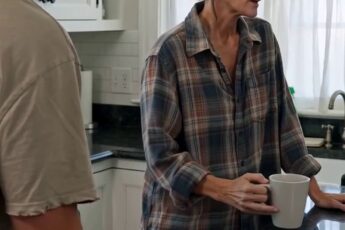
“Sorry we couldn’t scrape together money for flowers,” my mother-in-law Marilyn said, smoothing the lap of her new skirt like she’d just stepped off a yacht. “You understand, right? Budgets are tight.” She smiled that tight, pitying smile that always made me feel like I’d asked for a kidney. It was my fortieth birthday, and she’d brought a grocery-store cake—chocolate with frosted roses that looked like they’d melted and re-frozen twice, the price sticker still on the bottom: $12.99. No card. No gift. Just that sad, cellophane-wrapped apology.
I’d spent eight hours on my feet at Shear Perfection, blow-drying Karens and painting acrylics on teenagers who tipped in loose change—I think I netted $4.85 in nickels and dimes off a full set of glitter nails. After my shift I came home and baked a lemon poppy seed cake from scratch, made a spinach dip, chopped enough salad to fill a kiddie pool, and set the table with the good plates while my husband Greg shuffled around “helping” by refusing to find the trivets. By six-ten or so my sister Molly, my best friend Tara and her husband Jay, and Marilyn were all wedged into our tiny apartment living room. I was still in the soft slippers I’d collapsed into the second I’d switched off the oven.
Marilyn’s eyes found my feet instantly. “Oh, you’re wearing house shoes to your own party?” She laughed, but it came out like a little jab. “Goodness, Diana, we’re not at a slumber party. You’d think a real hostess would put on proper heels.”
Tara shot me a look across the coffee table. I forced a smile and popped a bottle of La Marca Prosecco I’d grabbed at Costco.
Marilyn herself was dressed to kill. A charcoal pencil skirt with the tags still dangling from the waistband, a silk blouse that probably cost more than our rent—which was $1,800 a month, and that blouse alone had to be pushing four hundred—and she kept smoothing the fabric and telling Molly about some “insane clearance sale” that let her snag the whole ensemble for a song. The skirt was new, brand-new, and I was pretty sure it hadn’t been anywhere near a clearance rack. The tag was from Saks.
We’d barely gotten through the appetizers before she launched into it.
“You should have seen Sabrina’s wedding,” she said, addressing the whole table as if I’d evaporated. “The reception was right on the water—panoramic windows, chandeliers the size of kitchen tables. The dress was made of actual Belgian lace. Antique. Hand-sewn. We had peonies flown in from Holland because Sabrina absolutely refused to settle for local flowers. Can you imagine? Holland! The fragrance, oh my god, it was like walking into heaven.”
Sabrina was Marilyn’s niece, her younger sister’s daughter. I’d met Sabrina once at a family barbecue six years ago. She’d forgotten my name and nodded. Now, thanks to Marilyn, I knew every detail of her wedding: the color of the napkins, the harpist’s set list, the precise number of crystals on the cake topper. This was maybe the twentieth telling, and tonight’s version came with extra vigor.
Molly shifted uncomfortably. Jay stared at his plate. Tara squeezed a lemon wedge into her water and stared straight at me.
Marilyn kept going, her voice bell-clear and giddy. “I told Sabrina’s mother, ‘Honey, you’re not well, you let me handle it.’ And I did. I swear I spent four months finding that venue. The girl is just like a daughter to me. She looked like an actual princess. When she walked down the aisle, I cried so hard my mascara ran down to my chin.”
She dabbed her eye dramatically. I watched a tiny piece of spinach quiver on her fork.
“Marilyn,” I said, cutting through the wedding soundtrack. My voice came out flat, a little shaky. “It’s my birthday. Can we, just for tonight, skip the Sabrina retrospective? Please?”
Her fork stopped in mid-air. Her perfectly drawn eyebrows lifted into two perfect arches. For one brittle second the room froze.
“I was just sharing family joy,” she said, voice turning wet and wounded. “You always twist things, Diana. You search for negativity where there is none.” She dabbed her eye again, slower this time.
Then she leaned over to Greg and started whispering, her lips moving fast, fury in the rhythm. Her hand rested on his arm like she was planting a flag. Greg’s face fell into that familiar guilty-puppy expression I’d seen a thousand times, the one that said I’m sorry but I can’t say it out loud. He wouldn’t meet my eyes. He just nodded faintly, swallowed, and reached for the pepper as if ground black pepper could solve anything.
Tara changed the subject to some Netflix documentary she’d watched, and the party limped forward. I chewed a piece of salami and tasted nothing.
By 10:22 everyone had gone. Molly hugged me extra long. Tara whispered, “You’re a saint,” and then she and Jay escaped to their quiet, mother-in-law-free world. Greg planted himself on the couch, his phone already in hand—the game’s highlights reflected on his beat-up iPhone 11—volume rising like a wall between us.
I stood over the kitchen sink, scraping congealed ranch dressing off a salad plate, when I heard it.
Our building has walls so thin you can hear the neighbor’s microwave beep. Mrs. Kowalski, the 74-year-old widow in the unit next door, was on the phone again, her voice amplified through the drywall like a one-woman radio show.
“Oh, my daughter-in-law Megan is just a treasure,” she was saying. “Brought me a whole pot of chicken soup when I had that cold last month. Never a cross word. Honestly, what would I do without her? She’s better than a daughter, I swear.”
I shut off the faucet. The water gurgled and died. It was 10:38 by the microwave clock.
Mrs. Kowalski’s daughter-in-law was a fifty-something librarian who visited twice a week. I saw her sometimes in the hallway, carrying grocery bags. She looked tired. But she came. She brought soup. And her mother-in-law bragged about her into a landline receiver loud enough for the whole building to hear.
My hands went still in the dishwater. A hot, sharp ache bloomed in my chest, and I realized my knuckles had gone white against the plate. I set it down carefully on the drying rack, dried my hands on my jeans, walked into the living room, and turned off the TV.
Greg looked up, mouth open. “Hey, the game’s on—”
“I’m going to Molly’s for a few days,” I said.
His eyes narrowed. “What? Why?”
“Because I baked a cake and made a dinner and your mother brought a twelve-dollar chunk of sugar from a discount bin and spent the whole night talking about Sabrina’s wedding like I don’t exist. And you sat there, Greg. You sat there and let her whisper whatever poison she was selling while I washed my own birthday dishes.”
He leaned back, rubbing his jaw. “She’s my mom, Dee. You know how she is.”
“No,” I said, louder now. “I know how you let her be. You let her treat me like furniture, and I wash dishes and I smile. I’m forty years old and I’m done.”
“You’re overreacting. It was just a stupid wedding story.”
“It’s never just a story. It’s a message. And the message is I don’t matter.”
He stared at me for a long moment, his mouth forming syllables that never made it out. I grabbed my duffel bag from the closet, threw in a few shirts and my toothbrush, and walked out the door while his voice rose behind me, still trying to call it a small thing.
I stayed at Molly’s that night with her cat purring on my feet and didn’t sleep much. The silence wasn’t so heavy anymore. Now it felt like waiting to be used.
The next morning I called Marilyn and asked her to meet me at the Daily Grind on Chestnut Street. She arrived ten minutes late, in a powder-blue trench coat, carrying a tote bag that probably cost as much as my monthly insurance premium. She ordered a vanilla latte with oat milk and extra foam—$6.75, I read upside down on the register—and settled into the chair across from me like a queen reviewing a petition.
“I hope this is important,” she said, tucking a copper curl behind her ear. “I have a yoga class at eleven.”
I laid my hands flat on the table. They were trembling a little. “You’re going to stop speaking to me the way you spoke last night. And you’re not going to walk into my home and treat it like a backdrop for your performance anymore.”
Her latte cup paused halfway to her lips. “Excuse me?”
“No more degrading my shoes, my food, my choices. No more calling me sensitive when I ask you to stop. And you won’t show up unannounced expecting me to smile while you tell me I’m not good enough.”
She laughed, a short, incredulous puff. “You think Greg will ever side with you over me? I raised that boy. I am his mother.”
“Then it’s time he acted like a man instead of a boy hiding behind his mommy’s skirt,” I said, my voice cracking a little on “skirt.”
Marilyn’s eyes flashed. She opened her mouth, but right then the café door jingled and Greg walked in—pale, hands in his pockets, but also fumbling with his keys, dropping them on the tile. He scooped them up, found our table, and just stood there for a beat, looking at his mother, then at me. I’d texted him the time and place an hour ago with one line: If you want a wife, you show up.
He pulled out a chair, sat on my side, and faced her. His jaw was tight, but his knee jiggled under the table.
“Mom,” he said, and his voice caught. “I, uh. Diana’s right. The way you treat her… it’s gotta stop. I mean, the cutting little comments, the—the stories that make her feel like she’s invisible. And if you can’t—if you can’t just be respectful, then you, um… you won’t be welcome. In our place. No, like, Sunday dinners or phone calls either.” He swallowed. “I’m serious.”
Marilyn sat motionless. The foam on her latte trembled.
“You would choose her?” she whispered.
“I already did.” His voice wobbled, but he held it.
The silence stretched out, thick and awkward. Then Marilyn pushed her chair back so hard it shrieked against the floor. She grabbed her tote, pulled a crumpled twenty from her wallet, and tossed it on the table without looking.
“You’re a manipulative little nobody, Diana,” she hissed, her voice cracking. “You’ve poisoned him against me.” She turned and strode toward the door with a dramatic spin, her trench coat billowing. The door rattled shut behind her. The whole café seemed to exhale.
Greg looked at me, his brown eyes shiny with something raw and unguarded. “I’m sorry,” he said, and his voice was still a little shaky. “For all of it. I should’ve said something a long time ago.”
I nodded. “Okay.”
We didn’t touch. We didn’t cry. We sat there in the rumble of the espresso machine until my heart rate eased below a gallop.
Later that afternoon, back at our apartment, I was making a pot of tea when I heard Mrs. Kowalski again. Her voice drifted through the wall, faint and warm.
“Yes, my Megan is bringing her famous banana bread tomorrow. I can’t wait. She’s such a gift.”
I poured the boiling water and watched the steam curl up and disappear. Outside the window, a bus groaned down the street. I took a sip of tea and smiled.