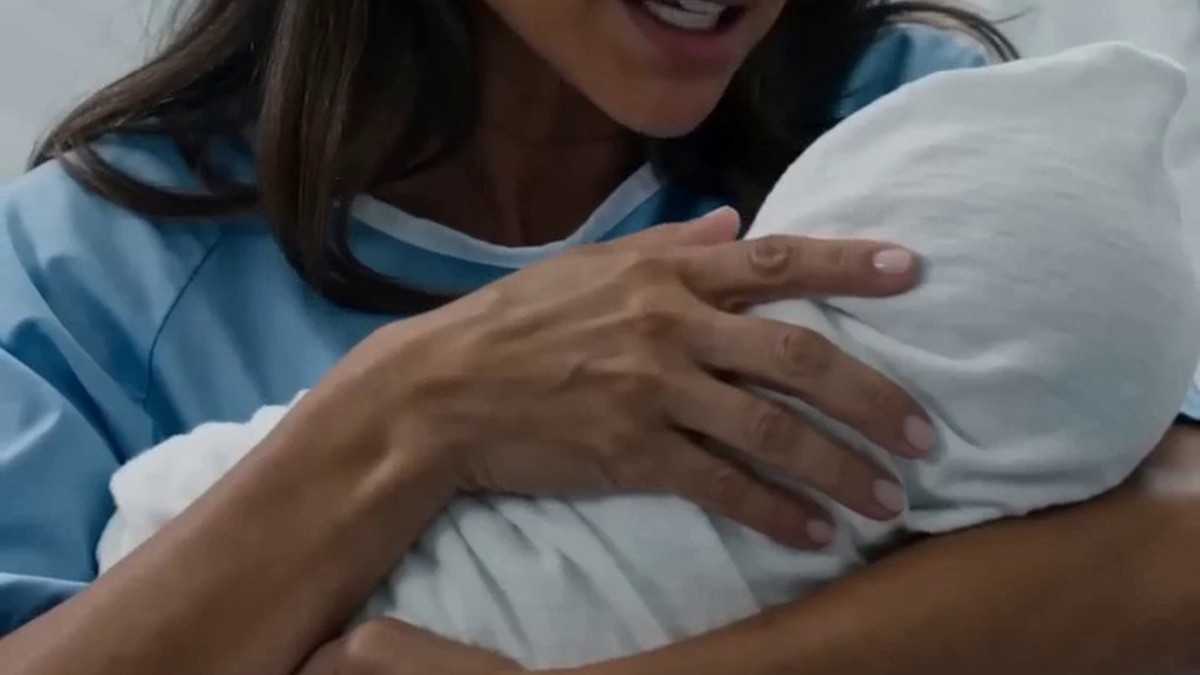
The moment my sister Becca and her husband Cole walked into the hospital room, I knew something had snapped in the universe. They stood frozen just inside the doorway, staring at the newborn girl on my chest like she was a sweater they’d ordered online and the color was off.
Becca’s face, which I’d seen radiant with hope for nine months, just… shuttered. Cole took two heavy steps forward, looked down at the baby, and the blood drained from his face so fast I thought he might hit the floor.
“What?” My voice was a croak. I’d been in labor for sixteen hours. “What’s wrong?”
Becca took a step back. An actual step back. She looked at Cole, and he slowly shook his head.
“This is a mistake,” he said.
I clutched the baby tighter. She was so warm, a perfect, tiny weight. “A mistake? She’s healthy. She’s perfect.”
Becca’s voice was a trembling whisper. “No… it’s not the baby we were waiting for.”
I felt a cold, sharp dread spread through my chest. “You’re not making any sense.”
She finally looked at me, and I saw something in her eyes I’d never seen before. Not love. Not gratitude. It was a clinical sort of disappointment. “We’re not taking this child home, Jenna.”
The words didn’t register. They just hung in the sterile air of that Phoenix hospital room, meaningless sounds. Outside, the July sun was bleaching the asphalt white-hot, but inside, a deep freeze had settled over us.
You have to understand, Becca and I weren’t just sisters. Our mom used to call us a single soul split between two bodies. We survived our parents’ ugly divorce together. We built blanket forts and told each other secrets that would make a priest blush. When she got the diagnosis—a uterine anomaly that meant she could never carry a pregnancy to term—I watched a part of her die. For a year, she was a ghost. She’d sit on my back porch in Scottsdale, nursing a single glass of white wine all evening, staring at the pool. Her husband, Cole, a tall, quiet man who owned a chain of auto-body shops, looked perpetually lost.
So when she finally asked me, a year later, I was ready. I was thirty-nine. My own son, Leo, was fifteen and already more interested in his guitar than me. My body wasn’t what it used to be, but my heart remembered every tear she’d wiped away, every nightmare she’d woken me from when we were kids.
“Jenna, please,” she’d said, gripping my hands so hard my knuckles cracked. Her eyes were red-rimmed pools of desperation. “You’re my only hope. I trust you with my life. With more than my life.” Cole had sat beside her, not saying a word, just nodding, his jaw tight.
I said yes.
The pregnancy was textbook. Becca was at every appointment, her hand on my belly a constant, gentle pressure. She cried when we first heard the heartbeat, a sharp, happy sob. She threw the baby shower, a ridiculously over-the-top affair with a three-tiered cake and a string quartet in her backyard. She’d talk to my stomach for hours. “My little miracle,” she’d whisper. The agreement was solid, airtight. A legal surrogacy contract drawn up by one of the best family attorneys in Maricopa County.
And I was happy. Genuinely, deeply happy to give her this gift.
But now, in the delivery room, with the scent of antiseptic and sweat in the air, that happiness had curdled into something grotesque. The nurse, a young woman named Maya with kind eyes, was looking between us, clearly baffled.
“Ma’am? Is everything all right? She’s a healthy little girl. Apgar scores are perfect.”
Cole rubbed the back of his neck, a nervous tic I recognized. “It’s not about her health.”
I stared at my sister. “Then what? What on earth is it, Becca?”
She wouldn’t meet my eyes. She was staring at the baby’s head. “She… she has a birthmark.”
I looked down. On the baby’s right temple was a small, flat, reddish-purple mark, a port-wine stain the size of a dime. The doctors had already checked it. Totally benign.
“So?” I said, my voice rising. “It’s just a little mark. It’ll probably fade.”
Becca flinched. “The genetic counselor… before the implantation… she said the donor profile was flawless. We paid extra. We specified. No family history of anything… visible.”
I felt like I’d been slapped. The world shifted out of focus. “You’re rejecting her… because of a tiny, harmless birthmark? Are you hearing yourself?”
“It’s not just that,” Cole cut in, his voice a low, edgy growl. “It’s a sign. A sign something else is wrong. We wanted a perfect… a clean start. We should have had a say in this.”
“A say?” I spat the words out. “You had a say. You chose the embryo. This is your daughter. A human being who is breathing on my chest right now. Her heart is beating. And you’re standing there talking about a refund policy?”
That was it. In that moment, the word “daughter” hit me with the force of a physical blow. My daughter. Not Becca’s. Mine. I had felt her first kick. I had endured the sleepless nights and the swollen ankles. I had pushed her into the world, and the first voice she heard was mine. The biological truth was a legal technicality on a piece of paper; the primal truth was a living, breathing girl in my arms.
Becca started to cry, but they were tears of self-pity, not sorrow. “You don’t understand, Jenna. Everyone will stare. They’ll whisper. We have a certain standing in the community. This will be… a lifetime of explanations.”
I smiled then. It was a cold, hard smile that I didn’t know I had in me. “No, Becca. I understand perfectly. You two are the biggest disappointments I have ever seen.”
Maya the nurse subtly positioned herself between us and the door, her body language protective. I gave a tiny, almost imperceptible shake of my head to her. It’s okay. I’ve got this.
I took a deep breath, and the decision I made was as clear as glass. I looked at Cole. “You’re a lawyer, right? The contracts are your thing.”
He blinked, thrown. “Well, yes, corporate—”
“Good. Then you’ll understand the concept of abandonment. According to Arizona Revised Statutes § 8-201, abandoning a child signifies a failure by a parent to provide reasonable support and to maintain regular contact. Failure to provide such support and maintain contact for a period of six months is prima facie evidence of abandonment, which is grounds for termination of parental rights. You two walked in here as the intended parents and declared, on the record with a witness present, that you’re refusing to take the child. That’s not a return. That is abandonment at minute one of her life.”
The color returned to Cole’s face in two furious red spots. “Now wait just a damn minute.”
“No, you wait.” I cut him off, my voice surprisingly steady. “The surrogacy contract you signed stipulates you can’t just refuse to take a child without severe financial and legal repercussions. But beyond that little piece of paper, you just made it clear to a mandatory reporter—” I gestured to Maya, whose eyes were now wide as saucers, “—that you are rejecting a healthy infant for non-medical, cosmetic reasons. You want to see a ‘lifetime of explanations’? How about explaining to a judge why you abandoned your newborn because she didn’t match your color palette?”
Becca just stared, her mouth opening and closing like a fish. I’d seen her throw tantrums over a broken nail, manipulate our father to get a new car, but this was a new level of monstrous, and she didn’t even see it.
“I’m keeping her,” I said. It wasn’t a declaration. It was a fact, as simple and solid as gravity. “My name is on the birth certificate application as the birth mother. You have nothing until a court says otherwise. So get out. Now.”
They left. They actually turned around and shuffled out of the room, shells of the people I’d grown up with. The silence they left behind was profound.
I looked down at the baby. She was quiet, her unfocused newborn eyes seeming to look right through me. The little mark on her temple pulsed slightly with her heartbeat. “Well, kiddo,” I whispered, my voice cracking for the first time. “It’s just you and me now. And Leo. He’s going to be a very confused big brother.”
I called my son from the hospital bed. “Leo, honey, change of plans. You’re not getting a cousin. You’re getting a sister.”
The phone was silent for a beat. “Mom… what did Aunt Becca do?”
His voice was so much like our father’s, steady and practical. “Something they’ll write terrible Yelp reviews about. I’ll explain later. Can you get the crib down from the attic?”
He didn’t ask any more questions. “Sure, Mom. What’s her name?”
I looked at the tiny, perfect face, the defiant little birthmark that had scandalized two narcissists. “Lily.”
The next six weeks were a blur of legal filings and sleepless newborn nights. Becca and Cole, true to form, tried to sue me for breach of contract, for the return of “their genetic material,” for emotional distress. My attorney, a fierce woman named Dianne who specialized in the murky waters of family and reproductive law, had a field day. The email where Becca’s lawyer demanded a DNA test to prove the baby was “faulty” was the final nail in their coffin.
“This is a gift, Jenna,” Dianne had said, her voice crackling over the phone. “The court won’t just dismiss their petition. They’re going to sanction them.”
The final court hearing was in a cramped, windowless room in the Maricopa County Superior Court. The air conditioner was broken, and the air was thick with tension. Becca showed up in a perfectly tailored cream-colored suit, a string of pearls, and an expression of wounded dignity. Cole was beside her, looking like a man forced to deal with a major inconvenience.
The judge, a no-nonsense woman with sharp glasses, read the case file with a visibly growing disgust. Then she looked up and pinned Becca with a stare.
“Mrs. Davis, help me understand. You and your husband initiated a surrogacy, approved the embryo, and then, upon seeing the perfectly healthy child, rejected her. In the hospital room. Because of a minor, harmless nevus flammeus. Is that correct?”
Becca’s lawyer started to object, but Becca, ever the one to take center stage, spoke up. “Your Honor, we had a vision. That baby didn’t fit it. We felt… misled. We have rights.”
The judge removed her glasses and leaned forward. “You have rights?” Her voice was dangerously quiet. “Let me tell you about the rights of a child. She has a right not to be treated like a defective product. She has a right to a parent who doesn’t see her as an accessory. You didn’t just breach a contract, Mrs. Davis. You forfeited your claim to humanity in my courtroom.”
She banged the gavel. It was swift. Brutal. My maternal rights were confirmed, their petition was dismissed with prejudice, and their parental rights were terminated on the grounds of abandonment. Just as I’d read in the statute.
The hallway outside was a silent, echoing space. Becca walked past me, her heels clicking a furious staccato on the terrazzo floor. She couldn’t resist one last, venomous whisper.
“You stole my daughter. I will never forgive you for this.”
I didn’t turn to look at her. “You didn’t lose a daughter, Becca,” I said to the empty hallway. “You gave one back like a piece of mail. And you lost a sister. Don’t confuse your tragedies.”
That was over two years ago now. I’m forty-one. I’m a single mom of a teenager who plays in a terrible garage band and a toddler who insists on wearing a different tutu every day, even to the grocery store. Leo is Lily’s fierce protector, and the first thing he does every morning is kiss her right on the birthmark she calls her “star.”
Yesterday, we were at a park. Lily was on the swings, her dark curls bouncing, the small purple mark on her temple catching the sunlight. A little boy pointed at her and asked his mother, loud enough for me to hear, “Mommy, what’s that on her face?”
My stomach clenched, ready for the awkwardness.
But his mom just smiled, took her son’s hand, and knelt down. “That,” she said, pointing to Lily like she was showing him a rare wildflower, “is where an angel kissed her before she was born. It’s a beauty mark.”
And Lily, hearing that, looked at me from the swing and just beamed. That’s the only explanation either of us will ever need.