
The night of my senior prom, I walked into the Hilton ballroom with my grandfather, Leo, and about half the room went dead silent. The other half snickered like we were a sideshow.
Leo was dressed in the same charcoal suit he’d worn to my mother’s wedding. Seeing him in it, chin up despite the chair, nearly cracked me open right there. He’d given me everything. Prom was supposed to be my chance to give something back.
Then Tara Albright decided to open her mouth.
She glided over in this skin-tight red dress, champagne glass dangling from her fingers, her boyfriend Derek trailing behind her like a backup singer. Tara and I had been in the same orbit since freshman year—she had money, I had a part-time job at a diner, and she never let me forget the distance between those two things.
“Oh my God, Chloe.” Her voice cut through the music. “You brought your Make-A-Wish patient?”
A few people from her circle laughed. The sound stung like a slap.
My hands clenched around the handles of Leo’s wheelchair. I was about to spin him around and walk us both out of there—screw the hundred-dollar ticket, screw the dress I’d saved six months for. But Leo lifted his good hand, the left one, and gently touched my knuckles.
“Hold on, peanut,” he said, so quiet only I could hear.
Then he wheeled himself forward. One-handed. Slow. The rubber tires squeaked against the polished floor. People parted without thinking, the way crowds do when they sense something they don’t understand yet.
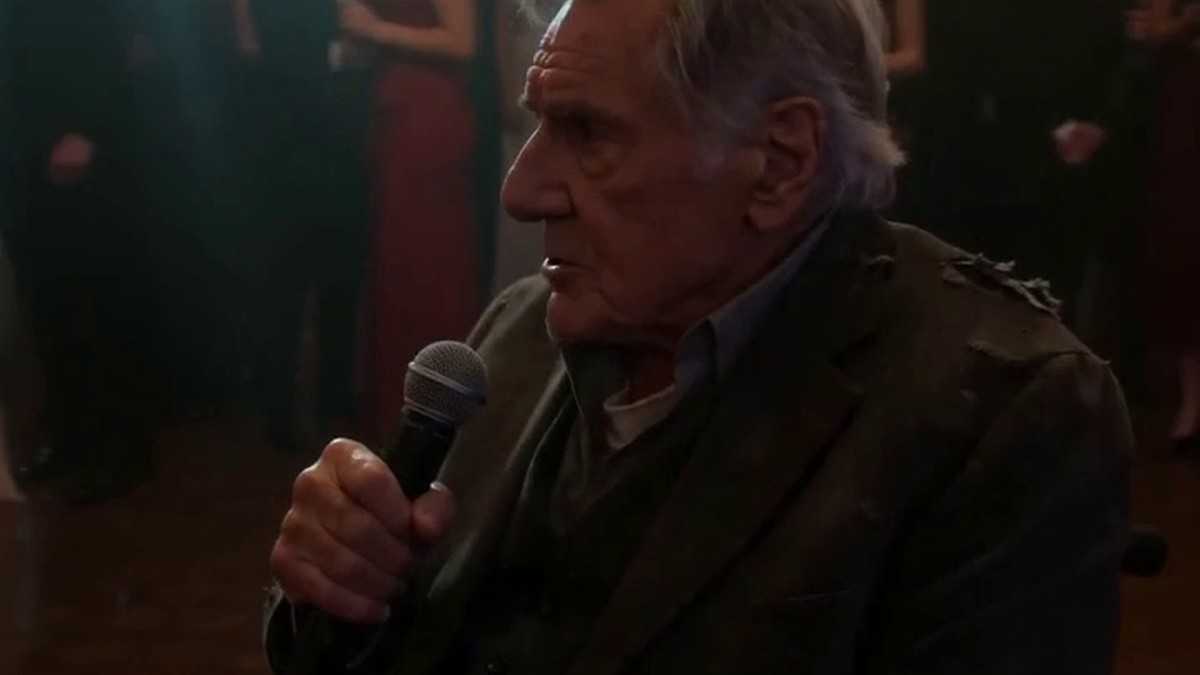
Leo stopped next to the DJ table and gestured for the mic.
The DJ, a guy in his twenties with a man-bun, looked confused. He glanced at the principal, who gave a tiny, uncertain nod.
Leo took the microphone. The feedback whined for a second, and then the room fell into that heavy, breath-held silence right before something breaks.
He looked out at two hundred seniors in glittering dresses and rented tuxedos. He looked at Tara. And then he said five words.
“I built the stage.”
Nobody moved. The principal’s face went slack.
Leo cleared his throat and kept going, his voice gravelly but steady. “The floor you’re all dancing on. The lighting rig overhead. The PA system that just played that song none of you paid attention to. I did all of it.”
He pointed toward the back of the ballroom with one knotted finger.
“That girl you just insulted? Her name is Chloe. She’s my granddaughter. And every single day for the last eighteen years, I’ve gotten up and worked so she could stand right here.”
The silence now was a different animal—thick, charged, unbearable.
I had known Leo was an electrician, sort of. I knew he’d worked construction. But he’d never told me exactly what jobs he took. I was eight when he started coming home with dust in his hair and bandages on his hands, and when I asked, he’d just say, “Helping some folks put on a show.”
This was the show.
Tara’s father, a real estate developer named Grant Albright, was standing near the refreshment table. He’d gone the color of spoiled milk. Because the Hilton ballroom renovation had been his big charity project. He’d plastered his name all over the donor plaque in the lobby. But he hadn’t paid for the stage crew. He’d asked Leo to do it at a “discounted rate.” A favor. And Leo had said yes, because Leo said yes to everything that might help me stay in this school district, in this town, in this life he was trying so hard to build for me.
“Mr. Albright,” Leo said, still into the mic, “you still owe me two thousand dollars for the materials. You’ve been dodging my calls for six months. I figure tonight’s a good night to settle up.”
Someone in the back—I think it was Marcus, the kid who ran the AV club—let out a low whistle. A few people laughed, but not at Leo. At Grant Albright, who looked like he wanted to crawl under the catering table.
Tara spun around to face her father. “Dad, what is he talking about?”
Grant’s jaw worked. He didn’t answer.
The principal—Dr. Harlow, a woman who’d known me since kindergarten—stepped forward then. She’d been biting her lip through the whole thing, clearly weighing liability against basic human decency. Decency won. She walked over, took the mic gently from Leo’s hand, and spoke in her calm, measured way.
“I think that’s enough excitement for one evening. Mr. Kowalski, would you like me to call a car?”
Leo shook his head. “I’ve got my car,” he said. “Just wanted to make sure everyone knew who built the place.”
He wheeled back toward me, and the crowd parted again. This time people weren’t just making way. They were clapping. Softly at first, then louder, a ripple turning into a wave. I saw kids who’d never said a word to me in four years suddenly looking at me with something like awe.
But I wasn’t watching them. I was watching Tara.
Her face had gone through a whole journey in the space of a minute—smugness, confusion, anger, and finally something I’d never seen on her before. Shame. Not the performative kind. The real, hollowed-out kind that settles into your stomach and stays there.
She turned on her heel and walked toward the exit. Derek hesitated, then followed her, but not before shooting an apologetic glance in my direction. I didn’t want his apology.
The rest of the night was strange and beautiful. Leo stayed by the wall near the windows, nursing a glass of ginger ale, while kids came up to him one by one. Some wanted to shake his hand. A few—kids whose dads had left or whose parents worked three jobs—said quiet things to him that made his eyes glisten. I danced with my friends. I took photos. I kept glancing over at Leo, and every time I did, he was holding court like a king.
Around eleven, Grant Albright reappeared. He walked up to Leo with an envelope in his hand and a tight, practiced smile on his face. The kind of smile that costs nothing and means less.
“Leo,” he said. “Let’s talk somewhere private.”
“We can talk right here,” Leo said. “Chloe’s the reason I do any of this.”
Grant’s smile strained. He handed over the envelope, and Leo tucked it into the inside pocket of his jacket without opening it. I would find out later that night that it contained a check for four thousand dollars—the two he owed, plus another two, which was probably hush money. Leo cashed it the next morning and deposited every cent into my college fund.
By midnight the prom was winding down. The slow dances had played. The prom king and queen had been crowned—a nice couple, genuinely kind, the kind of people who’d been crying quietly in the corner during Leo’s speech because they actually had souls. The lights came up, and everyone started drifting toward the parking lot, toward after-parties and diner runs and the long, giddy car rides where you scream along to songs about being young forever.
I wheeled Leo out through the side entrance, the one near the loading dock. The night air was cool and smelled like cut grass. Fireflies blinked in the hedges along the parking lot.
“You okay, peanut?” he asked.
“I should be asking you that,” I said. My throat was raw from holding back tears for three hours.
“This?” He tapped the arm of his wheelchair. “This doesn’t matter. You know what matters? You walked into that room with your head up. You didn’t let anyone make you feel small. That’s what I’ve been trying to teach you since you were old enough to understand words.”
I knelt down next to the chair and took his good hand. The skin was rough, callused, lined with decades of work. I thought about him running into a burning house when I was one year old. I thought about him learning to braid my hair from a YouTube video. I thought about all the parent-teacher conferences, the school plays, the time I fell off my bike and he carried me three blocks to the urgent care center, his own legs aching but his face showing nothing but calm.
The envelope in his jacket crinkled when he shifted. “Four years at state college, that’s what this pays for,” he said. “Maybe more. You just worry about the grades. I’ll worry about the rest.”
“You already worried about the rest,” I said. “You worried about the rest for eighteen years.”
He smiled. The left side of his mouth pulled up high; the right side stayed mostly still. “Best job I ever had.”
We sat there for a while, watching the fireflies. Somewhere across the parking lot, a car horn honked and kids screamed with laughter. The after-parties were starting. I didn’t care. There would be other parties. Other nights.
A black Mercedes pulled out of the VIP lot and glided past us. Through the tinted window I could just make out Tara in the passenger seat, her face turned away, her father gripping the steering wheel with both hands. They didn’t slow down. They didn’t look at us.
I stood up and unlocked the brakes on Leo’s chair. “Come on, old man,” I said. “Let’s get you home. I’ll make us some scrambled eggs.”
“Burnt, the way you always make them?”
“Always.”
He laughed—a real laugh, the kind that starts deep and rumbles up through his chest. It was the best sound in the world.
I loaded the chair into the back of our beat-up Honda, helped him into the passenger seat, and started the engine. The radio flickered on. Some old country song was playing—the kind Leo hummed while he worked. He reached over with his good hand and patted my arm.
We drove home through the quiet streets of our small town, past the school where he’d walked me to kindergarten every morning, past the park where he taught me to ride a bike, past the diner where I’d worked every summer since I was fifteen. The streets were empty. The houses were dark. The whole world felt like it was holding its breath, waiting for the next chapter to start.
When we pulled into the driveway, the porch light was still on. Leo had left it burning before we left for prom, just in case. He always did.





