
Clara Tillman could still hear the music, even from out here.
The bass thrummed through the barn’s old pine planks, rattling the windows of her truck. Inside, the Silverthorne Rodeo Queen Charity Gala was in full swing. She could picture it: the hay bales draped in fairy lights, the smell of barbecue and fresh sawdust, her friends in their best boots, spinning under the rafters. She’d been the queen once, two years ago. Before the horse.
She looked down at the wheelchair folded in the passenger seat. God, how she hated that thing.
Enough. She’d promised Martha she’d make an appearance. She hauled herself out of the cab and into the chair, the cold metal familiar and unforgiving. The dirt lot was a mess of potholes and loose gravel. She pushed hard, the wheels skidding, her shoulders burning with the effort.
A figure stepped out from the shadow of a beat-up old Ford. An old man, his face a map of sun and wind, wearing a patched barn coat that smelled of hay and engine grease. He was just standing there at the edge of the lot, staring at the glowing barn doors, a half-smoked cigarette forgotten between his fingers.
Clara rolled past him just as Mayor Burgess came strutting out, a glass of whiskey in his manicured hand. He was a broad man with a red face and a permanent scowl.
“Good Lord, what’s this now?” Burgess’s voice cut through the night. He wasn’t looking at Clara. He was staring at the old man. “Hey, buddy. You lost? This is a private event. Tickets were sold six months ago.”
The old man blinked. “Just listenin’ to the music. My daughter used to… Well, it’s a good band.”
“I’m sure they are,” Burgess said, not unkindly, but with the finality of a man used to giving orders. “But you can’t loiter here. Go on home now.”
Clara felt a knot tighten in her stomach. She’d known that dismissal her whole life, even before the chair. The way the world looks right through you when you don’t fit the picture.
“Wait,” Clara said, her voice sharper than she intended. She wheeled herself closer, the gravel crunching loudly. “He’s with me.”
Burgess’s eyebrows shot up. “Clara, for heaven’s sake. You can’t just invite every drifter…”
“He’s not a drifter. He’s my guest.” The lie came fast and sure. She looked at the old man. “Sir? I can’t dance, but if you’re just here for the music, I’d be honored if you’d sit with me.”
The old man looked at her. Not at the chair, but directly into her eyes. His were a pale, watery blue, but there was a sharp glint there, like a shard of flint.
“You’re the Tillman girl,” he said, his voice a dry rustle. “The one who rides. Rode.”
“Still ride,” she corrected him. “Just not on a horse.”
A ghost of a smile touched his lips. He crushed his cigarette under his boot. “Lead the way.”
Inside, the heat and noise hit them. The band was tearing through a two-step. People stared. They always stared. Clara led the old man to a quiet table near the back, away from the spinning couples and the judgment. Martha, her best friend, rushed over, her face a perfect picture of polite horror.
“Clara, who…?”
But before Clara could answer, Mayor Burgess was at their table again, this time with two members of the volunteer fire department who were working security.
“I’m sorry, Clara, but I have to put my foot down.” He wasn’t looking at her. He was looking at the old man. “Sir, I need you to leave. This is a fundraising event with very important donors. We have a specific dress code, and frankly, your presence is making people uncomfortable.”
The old man sighed, a long, tired sound. He started to push himself up from the table.
“Don’t,” Clara said, and the single word was a command. She turned on Burgess. “What exactly is he doing wrong, Tom? Breathing the same air as your donors? He’s a man who wanted to hear a country band.”
“He doesn’t belong here, Clara. Be sensible.”
“Oh, I see,” she said, her heart hammering against her ribs. “So this gala, my gala, the one that raised fifty thousand dollars for adaptive riding equipment last year, is a place where we decide who belongs?”
Burgess’s face reddened further. “You know that’s not what I mean.”
The old man, who had been silent, placed a calloused hand on the table. He looked at Mayor Burgess. Then he looked at Clara, his gaze dropping to her hands gripping the arms of her chair, to the slight tremor in her left leg she could never quite control.
“You’ve got fight in you,” he said to Clara, as if Burgess wasn’t even there. “You got that from your mother. But fightin’ him won’t fix what’s broke. You want to show him something he can’t ignore?”
Clara stared, confused.
“When was the last time you tried to stand up out of that chair? Not just a transfer to the truck. I mean stand. Just to see.”
“Three hundred and seventy eight days ago,” she said, the number falling from her lips before she could stop it. “That’s when the specialists in Denver told my dad I was a ‘complete’ case and to start saving for a custom van.”
Mayor Burgess scoffed. “Oh, for the love of—what kind of cruel game is this? This man is just a—he’s nobody. Security, get him out.”
Two young firefighters stepped forward, looking deeply uncomfortable.
“I’m not nobody,” the old man said, and his voice had changed. It was no longer a rustle. It was solid, like granite. He slowly reached into the inside pocket of his barn coat.
Burgess flinched, but the man only pulled out a worn leather bifold. He didn't open it. He just held it up.
“My name is Ellis Weaver. I retired here ten years ago. Before that, I was the head of neurological physiotherapy at the Johns Hopkins Outpatient Center for thirty-four years.” He glanced at Clara’s leg again. “I saw that tibial torsion the second you rolled across that gravel. It’s not a death sentence. It’s a frozen muscle chain, and it’s just screaming for a release that those Denver cowboys were too lazy to look for.”
The words didn’t make sense to Clara, but the tone did. It was the voice of absolute certainty. The one person in the whole barn who wasn’t looking at her with pity.
The band launched into a slow waltz.
Ellis Weaver leaned forward. “You want to dance, Clara? Not with your body. With that broken circuit between your hip and your heel. It’ll feel like dancing when it lets go. Do you trust me?”
She had nothing to lose. The pity, the sidelong glances, the quiet certainty that her life was half over—she was drowning in it. She’d rather die trying to stand than live another second sitting.
She held out her hand.
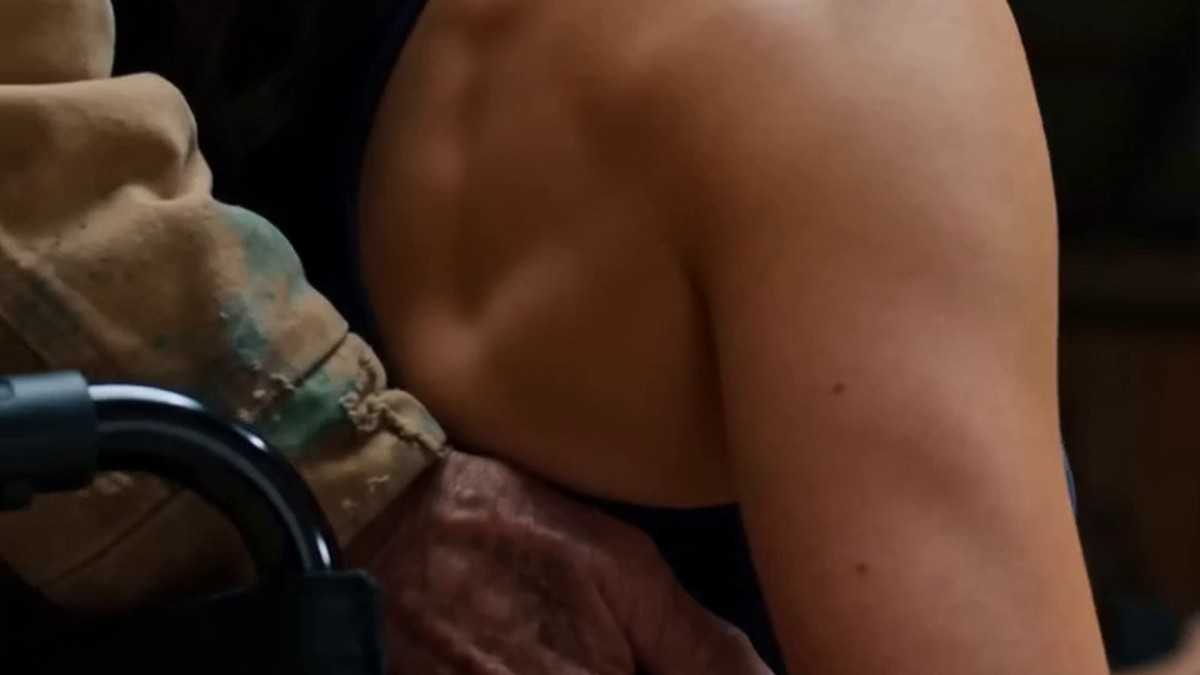
He took it. His grip wasn’t gentle; it was precise, his thumb finding a pressure point in her wrist. He didn’t pull. Instead, he stood, moved behind her chair, and placed one hand flat on the base of her spine, the other cupping just under her right hip bone.
“Close your eyes,” he whispered, so only she could hear. “Forget your legs. They’re just bones. I want you to breathe into my hand on your back. Now, don’t ‘try’ to stand. Just start leaning forward like you’re about to tell Burgess here to go to hell.”
A sob and a laugh caught in her throat. She leaned. Her spine curved into his hand. And something deep in her pelvis, a locked, frozen thing, yawned open. It was a tiny, internal shift, a sensation of release so profound that her vision swam.
“There it is,” he breathed. “Now, slide your right foot back, just a brush on the floor. Your body knows how. Let it.”
Clara thought of her mare, Lucy, the way a horse shifts its weight before a lope. She thought of the smooth floor. She slid her right heel back.
Her glutes and quads, silent for over a year, fired in a sudden, spastic chain reaction. It wasn't grace. It was a desperate, electric spasm of life. Her body, using his as a scaffold, unfolded upward. Her thighs pressed against the arms of the chair, then cleared them. She was rising, a shaky, lurching, impossible tower of effort and hope.
The entire barn went silent. The band fumbled out a wrong chord and stopped. Mayor Burgess’s whiskey glass hit the floor and shattered. Martha had her hands clamped over her mouth, tears streaming.
Clara was standing. Her legs were shaking so violently she thought the vibration would shake the barn down, but she was vertical, her weight fully on her feet, her knuckles white against Ellis Weaver’s shoulders.
She didn't take a step. She just stood there, weeping, her forehead pressed against the rough wool of his coat, smelling the hay and engine grease, the most beautiful smell in the world.
“My God,” Burgess stammered, his face pale. “It’s a miracle.”
Ellis Weaver, still holding Clara steady, looked over her shoulder at the mayor. His voice was a dry rustle again, but it carried in the silent barn.
“No. It’s sixty years of neurology and a girl with more guts than everyone else in this room put together. The real miracle is she had to wait this long for a broken-down old man to wander in off the street and do his job.”
Six months later, the Charity Gala was held in a newly built, fully accessible barn on Clara’s family ranch. She walked in on two arm-crutches, her gait slow and deliberate, the effort still a daily war, but a war she was winning. The first dance was a waltz, and she stood in the center of the floor, swaying with her dad, her feet planted, her hips finally free.
She’d spent weeks trying to find Ellis Weaver. The name wasn’t in any county record. The old Ford at the edge of the lot that night was gone before the song ended. He’d vanished as quietly as he’d appeared.
After the dance, Martha found her by the punch bowl, holding a small, folded piece of paper.
“Found it tucked in a wreath on the front door,” Martha said, her voice trembling. “It’s got your name on it.”
Clara opened it. The handwriting was a spidery, shaky scrawl.
*Clara—*
*You didn't need a miracle. You needed a spotter. The world is full of people who need a spotter to get under the bar and help them lift what they thought was too heavy. Be a spotter. Ellis.*
She read it three times, the ink blurring. He was right. That October, she drained half her trust fund and started “The Spotter Foundation,” converting the ranch’s old guest house into a short-term residential physio center. The head of neurology they hired was a bright, fierce young woman from Missoula who’d been Ellis’s last student.
The day they opened the doors, Clara sat on the new porch, watching a young vet with a spinal injury ease himself out of his truck, fear and hope fighting for space on his face.
She smiled at him.
“It’s a good band, isn’t it?” she said, nodding toward the country music playing softly from the barn.
He looked confused. “What?”
“Never mind.” She pushed herself up on her crutches and walked over to meet him.





