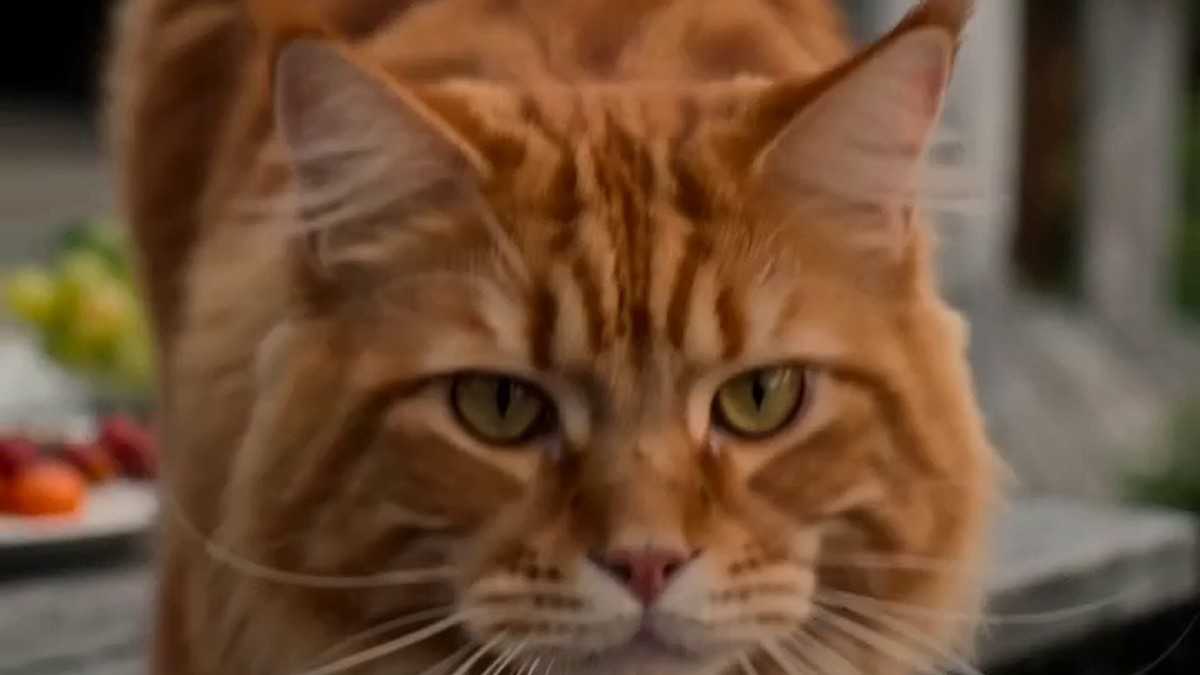
The first time I saw that cat, he was lounging across the top rail of the neighbor’s deck like a miniature lion overseeing the entire lake. Deep orange coat, massive paws, a ruff of fur around his neck that caught the sunset and made him look molten gold. Frank and Diane Patterson had picked him up from a breeder in Traverse City—two grand, maybe more—and they never let anyone forget it. He was a Maine Coon, purebred, with a tail that could sweep a coffee table clean.
Every Saturday when the whole row of lake houses fired up their grills and cracked the first beers, Ginger would appear. He didn’t beg. He’d just sit beside the picnic table, back straight, green eyes scanning the tree line like he was calculating property taxes. My wife Sarah couldn’t get enough of him. I’d toss him a piece of my ribeye and he’d accept it with the slow blink of a monarch granting a knighthood.
Our two cats, Moe and Curly—scrawny little gray rescue brothers with chewed-up ears—were the exact opposite. They’d scream for scraps, knock over a Solo cup if you ignored them, start a turf war with every squirrel in a hundred yards. Ginger, meanwhile, would finish his bit of steak, wash a paw, and then wade into the bushes to remind every trespassing tom exactly whose shoreline this was. He came back once with a scratch across his nose and Diane nearly fainted. “Do you know how much a vet bill for a cat like this costs?” Frank had muttered, but I saw the pride under the worry.
We all closed up the camps the first week of October. The weather turned fast that year—cold rain slapping sideways off Lake Bellaire, the oaks dropping their leaves in a single panicked night. We packed the truck, stuffed two yowling cat carriers onto the back seat, and pointed the Ford south toward Grand Rapids.
Two days later, I’m standing in my kitchen at home, patting my pockets, and my wallet isn’t there. Not on the counter, not in the truck, not in the duffel bag. Sarah just crossed her arms. “You left it in the nightstand drawer again.” She was right. I’d pulled out my insurance card for some work question on the last morning and never put it back. License, credit cards, the whole thing. So I drove back up—two and a half hours on a gray Wednesday with the wipers slapping—to grab it before the rain washed out the gravel road for good.
There’s a particular loneliness to a summer town in late autumn. The docks were pulled in, overturned canoes strapped down, every cabin window blinded by drawn curtains. Bare branches reached over the lane like fingers. I pulled up to our place, let myself in, found the wallet exactly where I’d left it, called myself seventeen kinds of idiot, and was halfway to the truck when some itch at the back of my skull made me stop.
The Pattersons’ place was shut tight. Green shutters locked, deck furniture piled in a corner, a Sportsman 1800 flipped over near the boathouse. I told myself they’d been gone for two weeks, that the orange flicker I thought I’d seen from the corner of my eye was nothing but wet leaves. But I’ve got a stubborn streak, and I knew if I drove away, I’d lie awake at three a.m. seeing it again.
Their gate was padlocked, so I climbed the split-rail fence, landed in a puddle, and cursed my own curiosity all the way to the French doors. That’s where I found him.
Ginger was pressed so tight against the threshold he looked like a wet throw rug someone had kicked to the side. His ribs stuck out. The coat that used to shine like a new penny was matted in dirty ropes, striped with mud, and he was shivering so hard his whole body vibrated. He lifted his head when my shadow fell over him, and his eyes went wide—not with hope, not yet. Just the blank exhaustion of something that had stopped expecting anything good.
“Hey,” I said, and my voice came out rougher than I meant. “Hey, buddy.”
He opened his mouth. No sound came out, just a tiny puff of air. Then he tried again, and this thin, cracked little mew scraped past his teeth.
I scooped him up. He weighed nothing—maybe five pounds, skin and bones under the mess of fur. He didn’t fight. He burrowed into the front of my jacket, jammed his head under my chin, and just shook.
The drive home, I kept one hand on the wheel and one hand inside my coat. He didn’t move.
Sarah met me at the door. She took one look at the bundle in my arms and her lips parted. “Is that—?”
“Found him at their place,” I said. “Curled up against the door. I don’t think he’s eaten in a week.”
“They must be losing their minds. He probably ran off while they were loading up and they couldn’t find him.” She already had her phone in her hand. “I’m calling Diane right now.”
“Hold on.” I set Ginger down on a blanket near the radiator. He just collapsed into it. “Before you tell her we’ve got him, just… ask how he’s doing. Casually. Please.”
Sarah gave me a long look, the one that means *you’re being paranoid, but I love you anyway*. She dialed.
I stood in the kitchen doorway, running my thumb over Ginger’s ear, while Sarah’s voice floated through from the living room. “Diane! Hi, yes, we’re all settled back in.… Uh-huh, the drive was fine.… Listen, I was just thinking about your beautiful orange cat—Frank’s pride and joy. How’s Ginger doing? I bet he misses the lake.”
Moe and Curly crept in from the hallway, both of them frozen mid-step, staring at the strange lump on their blanket.
Sarah’s tone didn’t change. “Oh, is that right? With her? In Cleveland?… Well, that’s wonderful. Give him a scratch behind the ears for us next time you talk to her.… Yeah, we’ll see you next summer. Take care.”
She hung up. She turned around. Her face was tight, jaw clenched so hard I could see the muscle jumping under her ear.
“Diane says Ginger’s living with their daughter in Cleveland,” she said, each word flat. “Happy as a clam. Never been outside a day in his life.”
I looked down at the shivering wreck on the blanket. The raw patch on his shoulder, the claw marks still crusted with dried blood from whatever fight he’d barely survived. Sarah walked over and knelt down. She didn’t say anything else. Neither did I.
Ginger stayed.
For the first three days, he barely moved from that blanket. Moe and Curly circled him like wolves, tails puffed, then gradually settled into a wary truce. By Saturday, Ginger had hobbled to the food bowl. By the following Wednesday, he was washing Curly’s head while Curly purred like an outboard motor. Something about his presence just recalibrated the whole house. The two gray brothers stopped brawling over the cat tower. They started sleeping in a pile, Ginger in the middle, a massive orange cushion with two little gargoyles tucked against his sides.
The winter passed. He filled out, muscle and bulk and that ridiculous ruff, until he looked like the cat I’d watched on the deck rail a year before. When spring came, Sarah said, “We’re taking all three of them to the lake, right?”
I didn’t answer. She knew the answer.
We rolled up to the cottage on the first Friday in June, windows down, the smell of pine and wet earth flooding the cab. The Pattersons’ lights were on. Their truck sat in the driveway. I got the grill going, set out the chairs, cracked a Two Hearted Ale, and waited for the knock.
It came around sundown. Frank and Diane, all smiles, tan already, a bottle of wine in Diane’s hand. “Dave! Sarah! How was your winter?” Frank’s teeth were so white they hurt to look at.
Their smiles lasted about six more seconds. That’s how long it took for the cottage door to swing open and for a massive orange cat to stroll out onto the deck, tail high, and survey the lake like he owned every inch of it.
Ginger stopped. He saw them. And then—slowly, deliberately—he turned his back, padded over to where Moe and Curly were already flopped in the grass, and settled down between them.
Frank’s face went the color of old concrete. Diane’s mouth opened and closed. The wine bottle tilted in her grip and nearly slipped.
Sarah and I turned away at the same moment. We didn’t say a word. I flipped a burger, listened to the sizzle, and waited for their footsteps to recede up the gravel path.
By the Fourth of July, the whole lake knew. The Pattersons kept to their own dock after that, faces hidden behind wide-brimmed hats, conversations dying whenever anyone got too close. But everyone else started showing up on our deck around seven p.m., coolers in tow, kids chasing fireflies, the smell of charcoal and citronella hanging in the air. They said they wanted to see the cat. The one they’d all watched last summer. The one who’d been left for dead.
So they’d pull up a chair, grab a drink, and there he’d be: Ginger, sprawled across the picnic table like he was posing for a Renaissance painting, Moe on his left, Curly on his right. Every plate that hit the table had an offering for him. Smoked brisket. Chicken thigh. The crispy fat edge off a pork chop. The two little gray brothers got their share too, same as always, because Ginger had made it clear: they ate when he ate.
Late one evening, after the last guest had wandered back across the lawn, I sat alone on the deck, nursing a beer. Ginger jumped up beside me, bumped his forehead against my elbow, and fixed his eyes on the dark water.
I scratched behind his ear, and he rumbled deep in his chest. The sound was so low I felt it more than heard it, a vibration that traveled from his ribs straight into mine. He didn’t need to say anything. Neither did I.