“Deliveries go around the back.”
The doorman didn’t shout it. That made it worse.
He said it politely, almost lazily, as if Edmund Clarke’s whole life could be explained by his wrinkled raincoat and scuffed brown shoes.
Outside, London rain slid down the windows of the grand auction house. Inside, the room glowed with money. Velvet chairs. Crystal lamps. Silver trays. Men discussing cars as if they were buying history by the kilogram.
And there, under a soft white spotlight, stood the dark green Aston Martin DB5.
Edmund stopped breathing for a moment.
He had known that car before it belonged to collectors. Before magazines wrote about it. Before men in tailored suits leaned close and called it “an investment.”
He had driven it once, decades ago, along the coast with the woman he later married.
She was gone now.
The car had vanished into private hands.
Tonight, Edmund had come to bring back one piece of her laughter.
At seventy-nine, Edmund Clarke was not poor. Far from it. He owned a private collection hidden in the Cotswolds and had quietly funded half the restoration programs in England. But he had always hated being recognized for money.
So he arrived in his old raincoat, carrying a folded umbrella and a memory.
The doorman stepped in front of him.
“This is an invitation-only event.”
“I have business here.”
A woman nearby smirked. “Perhaps he’s looking for the cloakroom.”
Before Edmund could answer, a young auction assistant appeared with a stack of paddles.
“I can help him,” she said.
Her name badge read SOPHIE WARD.
The doorman sighed. “Sophie, please.”
But she turned to Edmund. “May I see your name, sir?”
“Clarke,” he said.
She searched the list, then paused. Her eyes lifted.
“Mr. Edmund Clarke?”
“That’s right.”
Her expression softened with respect, but she said nothing to embarrass him.
“Your seat is ready, sir.”
The doorman went pale.
But the real humiliation came later.
When Edmund took his seat near the front, a senior manager approached and whispered just loudly enough for others to hear, “Some guests are uncomfortable. Perhaps you’d prefer a place less visible.”
Edmund looked at him.
“No,” he said. “I’ve spent enough of my life standing in the back.”
The auction started.
The Aston Martin opened at six million pounds. Bids came from Switzerland, Dubai, New York.
Edmund waited.
At nine million, he raised his paddle.
A hush fell.
At ten, he raised it again.
At eleven, the room surrendered.
The hammer struck.
Sold.
Then the auctioneer cleared his throat.
“Ladies and gentlemen, the winning bidder is Mr. Edmund Clarke, former owner of this vehicle and one of the most respected preservation collectors in Europe.”
A wave of shock passed through the room.
Edmund walked to the car and rested his hand on the roof. For a moment, he did not see the crowd. He saw his wife in a blue scarf, laughing as the wind pulled at her hair.
Then he turned to Sophie.
“You protected my dignity before you knew what it was worth,” he said.
One month later, Sophie became the auction house’s new director of client care.
The doorman was no longer at the front entrance.
And Edmund drove the Aston home slowly through the countryside, not to show anyone what he owned, but to remember what he had loved.
Because sometimes the greatest victory is not proving you are rich.
It is proving you were never small.
The insult was not what broke Edmund Clarke.
Not the doorman’s polite little smile.
Not the whispers from the velvet chairs.
Not even the manager asking him to sit somewhere “less visible,” as if old age and worn shoes were something to hide.
What broke him was the moment he touched the roof of that dark green Aston Martin and suddenly felt his wife’s hand over his.
For one second, the auction house disappeared.
No crystal lamps.
No wealthy guests.
No cold eyes watching him.
Only Margaret.
Her blue scarf fluttering in the wind.
Her laughter filling the old coastal road.
Her fingers tapping the dashboard as she sang off-key, pretending she knew all the words.
Edmund closed his eyes.
And for the first time in seventeen years, he whispered her name out loud.
“Margaret…”
Sophie Ward stood a few steps away, holding the keys with both hands. She had been trained to remain professional. Smile politely. Speak softly. Never show too much emotion in front of important clients.
But when she saw the old man’s shoulders tremble, she forgot every rule.
“Mr. Clarke?” she said gently.
He opened his eyes too quickly, as if he had been caught crying.
“I’m all right,” he said.
But his voice gave him away.
A room full of people had just watched him buy an eleven-million-pound car.
And yet he looked like a man who had just found a photograph in a drawer and realized the person in it was never coming home again.
The auctioneer was still speaking somewhere behind them. Guests were turning in their seats, whispering, staring, suddenly eager to know the man they had ignored only minutes before.
The senior manager came forward, pale and sweating around the collar.
“Mr. Clarke, I want to personally apologize for the misunderstanding earlier.”
Edmund did not look at him.
A misunderstanding.
That was what people called cruelty when they didn’t want to carry the weight of it.
Sophie saw Edmund’s fingers tighten around his folded umbrella.
For a moment, she thought he might finally raise his voice.
But he didn’t.
He only said, quietly, “You did not misunderstand me. You understood exactly what you wanted to see.”
The manager’s mouth opened.
No words came out.
Then Edmund turned back to the car.
“May I?” he asked Sophie.
She blinked. “Of course, sir.”
She handed him the keys.
His hand shook when he took them.
Not from weakness.
From memory.
The Aston’s door opened with a soft, familiar click.
Edmund stood frozen.
That sound alone nearly brought him to his knees.
Because some sounds do not belong to machines.
They belong to summers.
To young love.
To hands held at traffic lights.
To arguments forgiven before bedtime.
To the one person who knew how to sit beside you in silence and still make you feel completely understood.
He lowered himself into the driver’s seat.
The leather had been restored, polished, loved by strangers.
But when Edmund placed both hands on the steering wheel, he could still feel the ghost of the young man he had once been.
Beside him, the passenger seat was empty.
That was the cruelest part.
Sophie quietly stepped away to give him privacy.
But just as she did, Edmund reached toward the glove box.
“I don’t know why,” he murmured. “I just… I need to look.”
The glove box opened.
Inside were documents, restoration papers, a small velvet pouch…
And then something slipped down onto his lap.
A folded square of faded blue silk.
The room seemed to hold its breath.
Edmund stared at it.
His face changed.
Not shock exactly.
Not joy.
Something deeper.
Something that had waited seventeen years to hurt properly.
He picked it up with both hands.
It was Margaret’s scarf.
The same blue scarf from that drive by the sea.
The one he thought had been lost forever.
Sophie covered her mouth.
“Oh…”
Edmund pressed the silk to his lips.
And then, from inside the fold, a small envelope fell.
Yellowed with age.
Soft at the corners.
His name written across the front in handwriting he would have known in the dark.
Edmund.
The old man stopped breathing.
Around him, the rich room blurred.
He did not care who was watching anymore.
He opened the envelope with the careful hands of a man afraid that paper could feel pain.
Inside was a letter.
Only one page.
Margaret’s handwriting leaned slightly to the right, as it always had when she wrote quickly at the kitchen table.
My dearest Edmund,
If you are reading this, then somehow, this stubborn old car has found its way back to you.
He let out a sound that was almost a laugh and almost a sob.
Sophie turned her face away, but tears had already filled her eyes.
Edmund kept reading.
You always said cars were only metal and wheels. I never believed you. This one carried us when we were young, when we were foolish, when we still thought life would give us endless Sundays.
If I am gone by the time you find this, please do not let grief make you hard.
And please, my love…
Tell Lucy you forgive her.
Edmund’s hand dropped.
The name hit him harder than any insult that evening.
Lucy.
Their daughter.
The girl with Margaret’s eyes.
The girl who had once fallen asleep in his lap while Margaret baked apple pies on rainy afternoons.
The girl who had stopped calling him “Dad” and started calling him “Edmund” the year everything fell apart.
Sophie noticed the change in him.
“Sir?” she whispered.
Edmund stared at the letter as if it had become too heavy to hold.
For years, he had told himself that silence was dignity.
But sometimes silence is only fear wearing a neat coat.
Lucy had been twenty-eight when Margaret became ill.
Too young to lose her mother.
Too proud to show how terrified she was.
Too much like Edmund to know how to ask for help.
After Margaret passed, Lucy had stood in the kitchen, red-eyed and trembling, and said the words that broke them both.
“You loved that car more than you loved being home.”
Edmund had not shouted.
That was the problem.
He had gone quiet.
The kind of quiet that locks every door from the inside.
Two weeks later, he sold the Aston.
Not because he didn’t love it.
Because it hurt to know Lucy thought the machine had taken the place of her mother.
Then the years became stubborn.
Birthdays passed with short messages.
Christmas cards arrived with polite signatures.
Grandchildren grew taller in photographs he was too proud to ask for.
And now, inside the car he had come to buy for Margaret’s memory, she had left him the one sentence he had avoided for seventeen years.
Tell Lucy you forgive her.
Edmund covered his eyes.
The auction house remained silent.
No one dared whisper now.
Even the people who had laughed earlier seemed smaller in their expensive chairs.
Because there is a kind of pain money cannot protect you from.
And a kind of regret that can make an old man look like a lost child.
Sophie stepped closer.
“My mum used to say,” she said softly, “the words we don’t say become the heaviest things in the house.”
Edmund lowered his hand and looked at her.
“Your mother sounds wise.”
“She was,” Sophie said. “She cleaned offices at night. Raised me alone. Never had much. But she always told me, ‘If someone walks in looking tired, don’t make the world colder for them.’”
Edmund studied her face.
“What was your mother’s name?”
“Eleanor Ward.”
The scarf slipped slightly in Edmund’s hand.
“Eleanor?”
Sophie nodded.
“She passed three years ago.”
Edmund’s eyes filled again, but this time with recognition.
“I knew your mother.”
Sophie went still.
“You did?”
“My wife knew her first,” he said. “Years ago. At a charity sale in Bath. Your mother was working there, helping arrange the tables. Margaret came home that evening and said, ‘I met a woman today with the kindest hands.’”
Sophie’s lips parted.
Edmund smiled faintly through his tears.
“She said your mother gave her a cup of tea when she felt faint. Sat with her in the back room until I arrived. Margaret never forgot things like that.”
Sophie looked down, blinking hard.
“My mum never told me.”
“Kind people rarely keep lists of what they’ve done,” Edmund said.
That was when Sophie cried.
Not loudly.
Not dramatically.
Just one tear, then another.
Because all her life, she had wondered whether her mother’s small acts mattered to anyone beyond their tiny kitchen, beyond the bus stops in the rain, beyond the bills stacked beside the kettle.
And now an old man holding an eleven-million-pound car key had just told her that her mother’s kindness had lived quietly in someone else’s heart for decades.
Edmund folded Margaret’s letter and placed it carefully inside his coat pocket.
Then he looked at Sophie.
“Would you help me with one more thing?”
“Anything, sir.”
He gave a tired smile.
“Please don’t call me sir right now. I don’t feel very grand.”
Sophie nodded, wiping her cheek.
“All right… Edmund.”
He looked toward the entrance, where the rain still traced silver lines down the glass.
“I need to call my daughter.”
The phone in his hand looked almost strange, as if it belonged to another world.
He found Lucy’s name.
His thumb hovered.
Seventeen years of pride sat in that small pause.
Then Sophie whispered, “Make the call.”
So he did.
It rang once.
Twice.
Three times.
Edmund nearly ended it.
Then a woman’s voice answered.
“Hello?”
He closed his eyes.
For a moment, he could not speak.
“Dad?”
One word.
That was all.
Dad.
It moved through him like warm light entering a cold room.
“Lucy,” he said, and his voice cracked so badly that several people looked away to give him dignity. “I found something your mother left.”
There was silence.
Then Lucy whispered, “What do you mean?”
“A letter.”
Another silence.
“She told me to tell you…”
He swallowed.
Sophie stood beside him like a daughter might stand beside a father who had forgotten how to be brave.
“She told me to tell you I forgive you.”
On the other end, Lucy made a small broken sound.
But Edmund wasn’t finished.
“And I need to say something else before I lose the courage.”
He pressed Margaret’s scarf against his chest.
“I am sorry, my girl. I was there in the house, but I disappeared inside myself. You lost your mother, and then I made you lose your father too.”
Lucy began to cry.
Not the careful crying of adults.
The old crying.
The child crying.
The kind that comes from a place we keep locked for years.
“I didn’t mean it,” she said. “What I said about the car… I was angry. I missed Mum so much, and you wouldn’t talk to me.”
“I know.”
“No, Dad, I was cruel.”
“And I was proud.”
A long breath passed between them.
Then Lucy whispered, “I still have her apple pie recipe.”
Edmund laughed once, softly, through tears.
“She always burned the first crust.”
“She said that was for testing.”
“She lied beautifully.”
For the first time that evening, Edmund’s face changed.
Not into the proud collector everyone had just discovered.
Not into the humiliated old man they had first judged.
Into a father.
A tired one.
A late one.
But a father still.
“Come home,” Lucy said.
Two words.
Simple.
Small.
Everything.
Edmund looked around the auction house.
At the lamps.
At the velvet chairs.
At the guests who had mistaken price for worth.
At Sophie, who had protected him before she knew his name mattered.
Then he said, “I will.”
One month later, the front entrance of the auction house looked different.
Not because the marble had changed.
Not because the glass doors shone brighter.
Not because expensive people had become kinder overnight.
But because Sophie Ward now stood near the main desk with her name on a brass plate:
Director of Client Care.
She hated the title at first.
“It sounds too important,” she told Edmund when he visited.
He smiled. “Good. Grow into it.”
The doorman who had sent Edmund toward the back no longer greeted guests at that entrance.
The senior manager had learned, painfully and publicly, that politeness without respect is only insult in a clean shirt.
But Edmund never asked for anyone to be ruined.
Margaret would not have liked that.
Instead, he requested one change.
A small sign was placed near the doorway, simple and elegant:
Every guest enters with dignity.
Sophie cried when she saw it.
That evening, Edmund did not drive the Aston to impress anyone.
He drove it slowly out of London, past wet streets and glowing windows, through villages where porch lights blinked on one by one.
The leather seat beside him was no longer empty.
Lucy sat there, holding Margaret’s blue scarf in her lap.
She was fifty now, but under the dashboard light Edmund could still see the little girl who used to ask for one more bedtime story.
In the back seat sat Lucy’s daughter, Emma, twenty-one, quiet at first, watching her grandfather as if meeting not a stranger, but a missing chapter.
They drove all the way to the Cotswolds without turning on the radio.
Rain softened against the windshield.
The headlights swept across stone walls, sleeping fields, and old trees bending gently in the dark.
At one point, Lucy reached across the space between them and placed her hand over Edmund’s.
He did not speak.
He only turned his palm upward and held on.
Some apologies are too big for words at first.
So they begin as touch.
When they reached the house, it was almost dawn.
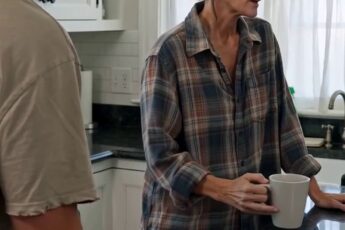
The kitchen smelled of apples.
Emma had brought a pie from a bakery near her flat, but Lucy insisted on warming it in the old oven, the one Margaret had loved.
“It’s not homemade,” Emma said shyly.
Edmund looked at her and smiled.
“Then we’ll pretend. Your grandmother believed pretending was half of cooking.”
Lucy laughed.
Really laughed.
And for a second, Edmund heard Margaret in it.
He had to turn toward the window.
Outside, the rain had stopped.
The sky was pale blue at the edges, and the garden glistened as if someone had washed the whole world clean.
On the kitchen table lay the old photograph Edmund had taken from the car that morning.
Margaret in her blue scarf.
Edmund younger, ridiculous and handsome in a way he had forgotten.
The Aston behind them.
The sea in the distance.
Lucy touched the photo with one finger.
“She was beautiful.”
“She was bossy,” Edmund said.
“She was both.”
They smiled.
Then Lucy leaned her head on her father’s shoulder.
Not dramatically.
Not like stories make it grand.
Just quietly, like someone finally coming home after standing too long in the rain.
Edmund lifted his hand and touched her hair.
For years, he had saved museums, restored rare cars, preserved history for strangers.
But that morning, in the soft yellow light of his kitchen, with steam rising from three cups of tea and warm apples scenting the air, he understood something Margaret had known all along.
The most precious things are not always lost loudly.
Sometimes they slip away in silence.
A missed phone call.
A swallowed apology.
A chair left empty too long.
And sometimes, if grace is kind, life gives you one small road back.
Edmund looked at his daughter.
“I should have said this years ago.”
Lucy squeezed his hand.
“Say it now.”
He took a breath.
“I love you, my girl.”
Her face folded.
Not because the words were surprising.
Because they were late.
And late words can still heal, if they arrive with truth.
Lucy wrapped her arms around him.
Emma came around the table and joined them.
Three generations stood in that old kitchen while morning opened slowly over the garden.
No applause.
No spotlight.
No auctioneer calling out a price.
Only a father.
A daughter.
A granddaughter.
And the quiet mercy of a second chance.
Later, when the tea had cooled and the pie was half gone, Edmund placed Margaret’s blue scarf over the back of the empty chair.
Not as a shrine.
As a welcome.
Because love, when it has been real, never fully leaves the table.
It waits.
In recipes.
In old photographs.
In the smell of apples.
In the hand that finally reaches back.
And sometimes, in a dark green car that finds its way home just in time to remind a family what still matters.
Have you ever had one sentence you wished you had said sooner — to your mother, your father, your child, or someone you still miss?