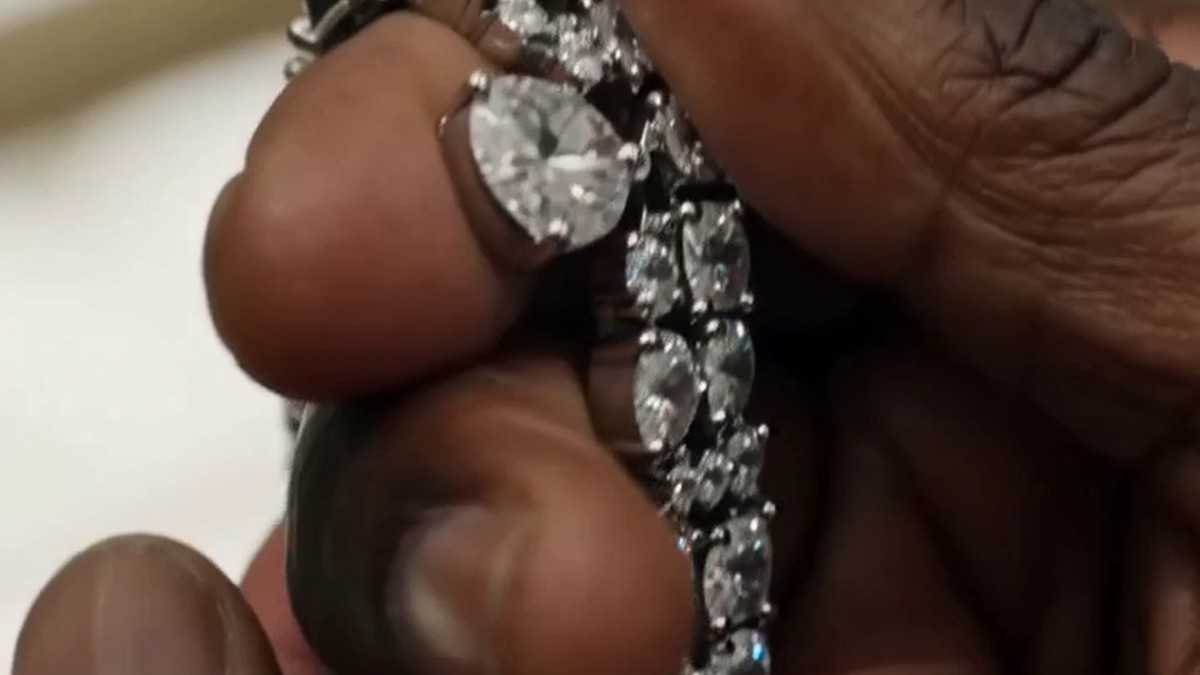
The sharp snap of the chain echoed through the boutique like a gunshot. Every head turned. A woman in a pristine cream coat stood in the center of the marble floor, holding a diamond necklace aloft as though it were a bloody knife.
"This is a joke, right?" Her voice sliced through the hushed atmosphere of high-end perfumes and soft spotlights. "You walked in here wearing diamonds you couldn't afford in three lifetimes?"
The woman she was shouting at stumbled backward, her shoulder blades hitting a glass display case. She was younger than her faded floral dress and threadbare wool coat suggested. Her hand flew to her bare throat, fingers trembling over the angry red mark where the chain had been ripped away. Tears brimmed, making the boutique's expensive lighting split into a thousand tiny rainbows.
"It was my mother's," she breathed.
The elegant woman laughed. Not a chuckle—a performance of contempt for the audience now openly gawking.
"Naturally. It always is. That's the go-to line for every thief who gets caught."
Cell phones rose like a field of black mirrors. Fingers tapped red record buttons. The young sales associate behind the counter stood paralyzed, her mouth slightly open, clearly weighing her minimum-wage paycheck against the fury of a woman who reeked of old money and dangerous connections.
The rich woman grabbed the necklace with both hands now, possessive and triumphant.
"Don't even look at it," she hissed. "You probably stole it from someone who actually deserved it."
*Thief.*
The word landed in the room and changed its chemistry. The soft murmurs turned sharp. Eyes that had been curious became accusatory. The poor woman's spine went rigid. She stopped crying. She just stared at her accuser with a strange, hollow stillness, as if that single word had unlocked something she'd been bracing for her entire life.
Then the workshop door at the back of the store burst open.
An old man in a jeweler's loupe and a leather apron stumbled out, wiping his hands on a cloth. His glasses sat crooked on his nose. He was breathing hard, as if he'd run a great distance in the ten steps from his bench.
"What's going on out here?"
The rich woman thrust the necklace toward him like a prosecutor presenting Exhibit A.
"This woman," she announced, "came into your establishment wearing a custom diamond piece she has no business owning. I'm calling the authorities."
The jeweler adjusted his glasses.
He looked at the necklace.
His face went the color of old paper.
"Put it down," he whispered. Then, louder, cracking with urgency: "Do not handle that necklace. Hand it to me. Right now."
The command was so absolute, so freighted with authority, that the boutique fell into a vacuum of silence. No one moved. No one breathed.
The old man stepped closer, his eyes flicking between the trembling young woman in the faded coat and the diamonds catching the light.
"That piece," he said, his voice suddenly hoarse, "was designed and fabricated by my hands, in this very workshop, for her mother. Over thirty years ago."
The poor woman's knees buckled. She caught herself on the edge of the case, a single sob escaping her chest.
The rich woman's triumphant smile didn't disappear—it eroded, grain by grain, as the weight of the jeweler's words settled over the room.
He extended his palm, steady now.
"Give it to me. Please."
Under the collective stare of two dozen strangers and six cell phone cameras, the rich woman reluctantly placed the necklace into his weathered hand. The old man turned it over with the reverence of a priest handling a relic. He worked the tiny, nearly invisible clasp and opened it to the inner curve of the pendant.
There, etched so delicately it was almost part of the metal's soul, was an engraving.
Tears spilled down the old man's cheeks.
"It's exactly where I put it," he murmured.
The crowd pressed in, straining to see. The jeweler lifted his gaze to the poor woman, who was now openly weeping, one hand clamped over her mouth.
"Your mother's name was Margaret," he said. "But she went by Maggie. She sat in that chair over there, with a baby girl in her arms, and told me what she wanted the inscription to say."
He cleared his throat and read aloud: "*For my girls—when they are together again.*"
"How do you know that?" the poor woman choked out. "How could you possibly know that?"
The jeweler's hands began to shake. He wasn't just a craftsman recalling an old commission. He was a human being about to detonate a bomb in the middle of a luxury store.
"Because I asked her what it meant," he said. "And she told me. She told me she had two little girls. You—the older one. Healthy, perfect, the light of her life. And a younger one. Born with congenital heart complications that required surgeries her family couldn't afford. The father had left. She was drowning in medical debt."
He paused, steadying himself on the display case.
"She said she'd made an impossible choice. She'd placed the younger baby with an adoption agency that could connect her with a family able to provide the medical care she needed. To save her life. She kept you, the older girl. Raised you alone, in a one-bedroom apartment, working double shifts, loving you with every scrap of energy she had left."
He turned the necklace over again, staring at the inscription.
"She came here that day, with the baby in her arms, because she'd finally saved enough from tips and overtime. The adoption was being finalized the following week. She wanted to create something that could never be lost, never be sold, never be pawned. A beacon. She said, and I will never forget her words, she said: *If life is cruel enough to separate them, maybe this will bring them back together again. If they ever hold it in their hands, let it tell them the truth.*"
The poor woman shook her head, her voice splintering.
"My mother only had me. I'm an only child. I grew up alone."
"No, sweetheart," the old man said softly, his voice breaking. "She didn't. You didn't. She wore that necklace every day of her life after I made it. When she passed, it was among her things—I know, because I kept in touch with her over the years. She left it for you. It must have just now found its way to you."
Anna's face crumpled with fresh understanding. "I only got the box yesterday. Her old landlady finally tracked me down after all this time. Said my mother had left it in storage, with a note asking her to give it to me when I was old enough to understand. I found the necklace inside this morning."
Mr. Aldridge nodded, his expression heavy with shared grief. "Maggie knew you'd need it someday. She just didn't know how soon."
Then he did something that made the air leave the room.
He turned. Slowly. Deliberately. And fixed his eyes on the rich woman in the cream coat.
"The baby she placed for adoption," he said, "was taken in by a wealthy family two towns over. The records were sealed. The name was changed. But I made it my business to know. A friend at the agency—he's long gone now, God rest him—he told me the new name in confidence, after Maggie was too sick to ever do anything with the information. He thought I could tell her children one day, if they ever came looking. I've waited thirty-two years for this."
The rich woman took a step back. Her heel caught on the marble and she nearly stumbled.
"This is absurd."
"The adopting family's name," the jeweler continued, relentless now, his voice carrying the weight of three decades of silence, "was the same name that appears on the deeds to half the commercial property in this city. I watched the news. I saw the society pages. I saw a little girl grow up in a mansion, with ponies and private schools and a trust fund big enough to buy this entire store, and I waited. I waited for the universe to do what it does."
A collective gasp tore through the boutique.
The rich woman's hand flew to her own throat, as if the necklace had been ripped from *her* neck now. Her composure—that shiny, bulletproof armor—cracked straight down the middle.
"You just assaulted your own sister," the jeweler said, his voice dropping to something almost reverent. "You ripped your dead mother's last gift off her throat. The gift she made for *both* of you."
Sound exploded. Whispers, gasps, one woman audibly saying "Oh my God" over and over. The cell phones were forgotten, held limply at people's sides.
The poor woman—the older sister, the one who'd been kept, the one who'd grown up poor but loved—slowly reached out. She took the necklace from the jeweler's open palm. Her hands were still shaking, but something new was hardening in her face. Her chin lifted. Her spine straightened. The tears were still falling, but they weren't tears of shame anymore.
She looked at the rich woman. The sister she'd never known existed. The sister who'd just called her a thief in front of a crowd.
And she asked a single question, her voice clear as a bell struck in a silent cathedral:
"Did you know?"
The rich woman's mouth opened. Closed. The color drained from her face until her designer lipstick stood out like a wound against white skin.
"I asked you a question," the poor woman said, stepping closer. "Did. You. Know. Who I was?"
The silence that followed wasn't empty. It was the heaviest, most damning silence in the world.
Because in that silence, the rich woman's face told the truth her mouth couldn't form.
Yes.
Yes, she had known.
—
The revelation landed like a physical blow. The poor woman—her name was Anna, though no one in that boutique had bothered to ask until now—felt the world tilt sideways. The sister. The rich, cruel, sneering woman who'd tried to publicly destroy her. This woman hadn't just randomly targeted someone who looked poor and out of place. She'd *known*.
"You knew," Anna repeated, not a question now. A statement of fact, delivered with the cold finality of a judge's gavel. "You saw me walk in, you recognized the necklace, and you decided to do this."
The rich woman—Victoria, as the monogram on her designer handbag announced—backed up until she hit a mannequin. It wobbled. She grabbed it for support, her knuckles white.
"You think you can just stand there and not answer?" Anna's voice rose. The meekness, the stammering, the apologetic shrinking—all of it had burned away in the fire of this revelation. "You saw our mother's necklace around my neck. The necklace she bought for both of us. And your first instinct was to rip it off and call me a criminal?"
Around them, the crowd had shifted. The phones were up again, but the energy had flipped. They weren't recording a rich woman exposing a thief. They were recording a rich woman being exposed as something far, far uglier.
Victoria finally found her voice. It came out thin and reedy, nothing like the commanding sneer from minutes before.
"You don't understand."
"Then explain it," Anna shot back. "Explain to me, to all these people, to the cameras that are definitely going to put this online, why you would do that to your own sister. Your own *blood*."
Victoria's composure crumbled entirely. She looked around the room like a trapped animal, searching for an exit that didn't exist. Every door led to more witnesses. More cameras. More judgment.
"Because you had her!" The words burst out of Victoria like a dam breaking. Ugly, raw, and completely uncontrolled. "You had her your whole life! You got the bedtime stories and the birthday cakes and the tiny apartment that was probably full of love, while I got… I got a mansion and parents who saw me as an accessory! I got nannies who quit every six months and a trust fund that was supposed to make up for the fact that no one ever actually wanted me!"
She was crying now. Mascara tracked down her cheeks in dark rivulets. The rich woman who'd been so terrifying ten minutes ago was just a wounded, raging, broken person in an expensive coat. With a jerk of her hand, she pulled at the collar of her silk blouse, revealing a thin, silvered scar that ran from her collarbone down toward her sternum. The mark of old, expensive surgeries.
"The adoption records said I was 'a fixer-upper baby with congenital defects,'" she spat, her voice laced with poison. "That's how my adoptive father described it. They paid for the best surgeons in the country. They 'fixed' me. And then they treated me like a renovated property—valuable, but never quite their own. I found the papers when I was nineteen. I hired private investigators. I found *her*—our mother—and I watched her from across the street. I saw her with you. I saw her laugh with you. I saw her hug you goodbye when you left for school. And I hated you. I hated you so much I couldn't breathe, because you had the one thing all my money could never buy."
Anna stared at her, the necklace clutched to her chest like a shield. Her eyes flicked to the surgical scar.
"She gave you up to save your life," Anna said, her voice quiet but carrying more power than any shout. "Those surgeries. That scar. That's the proof she loved you. If she'd kept you, you would have died. She told Mr. Aldridge as much. And she never stopped looking for you. Every year on your birthday, she'd light a candle. She wouldn't tell me why. She'd just say she was sending light to someone who needed it. I thought she was crazy. I thought it was some religious thing."
She took another step forward. Victoria flinched.
"She died of cancer. In a hospice bed that cost her every cent she'd ever saved. Her last words were a name. The name she gave you when you were born. A name I didn't even recognize. I thought the medication was making her hallucinate. She called out for you with the only name she ever had for you, and I didn't understand."
Victoria made a sound. It wasn't a word. It was something more primal—a keening, wounded noise that seemed to come from somewhere deeper than her throat. She knew the birth name. It was in the adoption file.
The jeweler, Mr. Aldridge, had been standing back through all of this, letting the sisters' reckoning play out. But now he stepped forward, holding something in his hand. A small velvet box. Worn. Old. Not from this boutique's stock.
"Your mother," he said, addressing both women now, "left something else. She came back. A year before she passed away. She knew she was sick by then. She'd never stopped saving, never stopped hoping. She asked me to make a second piece. A companion to the necklace. And she asked me to hold onto it, no matter how long it took, until the day both her daughters stood in the same room. She couldn't carry the weight of it herself anymore—she was too sick. She gave the necklace to her landlady for safekeeping and gave me this ring, making me promise to find you both."
He opened the box.
Inside was a ring. A simple band of white gold, set with two small diamonds that intertwined like branches of a single tree.
"Two stones. One for each of you. Grown from the same earth, cut from the same rough, just like you."
Anna looked at the ring. Then at Victoria.
Victoria looked at the ring. Then at Anna.
The crowd held its breath.
"I don't know if I can forgive you," Anna said. Her voice broke but didn't shatter. "I don't know if I'm strong enough to forget what you just did. What you were willing to let happen to me."
Victoria nodded, tears still streaming. She had no defenses left. No sharp words. No legal threats. Just the naked, ugly truth of who she'd become—a woman so poisoned by jealousy that she'd almost destroyed the only family she had left.
"But I know what our mother would have wanted," Anna continued. "She spent her whole life trying to bridge a gap she didn't create. She carried the guilt of a choice she made to save your life, and it crushed her. Every single day. I see that now."
She took the ring from the box. She held it in her palm, the two diamonds catching the light.
Then she extended her hand toward Victoria.
"I'm not going to call security," Anna said. "I'm not going to press charges. I'm not going to let the internet destroy you, even though it probably already is. But you're going to have to live with what you did. And you're going to have to decide if you want to be the person our mother hoped you'd become."
Victoria stared at the offered hand. At the ring. At the sister she'd just publicly humiliated.
Her hand rose. Trembling. Hesitant. She didn't take the ring. She placed her hand on top of Anna's, covering the ring between both their palms.
"I'm sorry," Victoria whispered. It was the first genuine thing she'd said all day. "I'm so, so sorry."
The boutique erupted. Not in chaos—in something closer to catharsis. Someone started clapping. Someone else was openly weeping. The sales associate who'd been frozen behind the counter was now wiping her eyes with a designer scarf that definitely wasn't meant for tears.
Mr. Aldridge, the jeweler who'd kept a dead woman's secret for three decades, simply nodded. His job was done. The necklace had found both its owners. The message had been delivered.
Anna didn't pull her hand away. She didn't forgive Victoria—not yet, maybe not ever. But she held on. Because that's what the older sister does. That's what her mother would have done.
Out of the corner of her eye, she caught a glimpse of herself in one of the boutique's gilded mirrors. A woman in a faded coat, standing next to a woman in a cream designer ensemble. One raised in poverty, one raised in wealth. One kept, one given away. Both holding onto the same ring.
Two girls, finally together again.
The necklace rested against Anna's heartbeat. Warm now, as if it had been waiting for this exact moment to finally feel complete. The diamonds caught the light, scattering tiny rainbows across the marble floor, connecting the two sisters in a bridge of refracted color.
"Okay," Anna said, her voice steady now. "Okay. Let's go somewhere and talk. Really talk. About her. About us. About whatever comes next."
Victoria nodded, unable to speak.
And together, the two women walked out of the boutique, past the stunned onlookers, past the still-recording phones, into a city that had just witnessed the cruelest kind of cruelty and the most improbable kind of grace.
Behind them, the jeweler closed the velvet box and placed it back on the shelf. He'd completed his final commission for Margaret, the woman who'd loved her daughters across the impossible divide of poverty and circumstance and death itself.
The necklace had done its work.
The girls had found each other again.