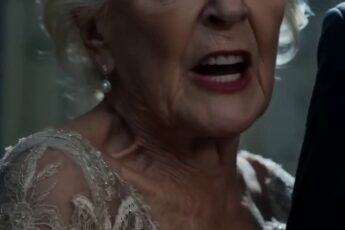
For a few seconds, Sophie believed silence could swallow a person whole.
She stood in a small countryside chapel in Vermont, holding a bouquet of lavender and baby’s breath. The wooden floor creaked beneath her shoes. Morning light fell across the aisle, soft and golden, as if the room itself still believed in happy endings.
But Mark did not reach for her hand.
Instead, he gave a tired smile and said, “Sophie, we both know this was never realistic. My world is different. You were never going to be comfortable in it.”
The words were calm. That made them worse.
Sophie blinked quickly, but the tears came anyway. Her veil trembled as she lowered her head.
From the front row, Mark’s younger sister, Hannah, stood up slowly.
“That’s not fair,” she said, not loudly, but clearly.
Sophie looked at her.
Hannah’s eyes were full of apology.
That was enough to help Sophie breathe again.
She turned to Mark.
“Then be honest now.”
Mark’s shoulders stiffened.
“Tell them you told your family I was simple because it was easier than admitting you were unsure. Tell them you let me love you while you were still trying to impress everyone else.”
The chapel was completely still.
Sophie took the folded vows from her pocket. Her handwriting was small and careful. She looked at the pages for a moment, then folded them closed.
“These words were real,” she said. “So I won’t waste them here.”
She handed the lavender bouquet to Hannah.
“Thank you for telling the truth with your face,” Sophie whispered.
Hannah began to cry.
Sophie walked down the aisle alone, but not lonely. Outside, the fields moved softly in the wind, and somewhere nearby, a church bell rang once.
She paused on the steps and pressed her folded vows to her heart.
The day had changed.
But she had not been ruined by it.
She had finally seen clearly.
For a few seconds, Sophie believed silence could swallow a person whole.
She stood in that small countryside chapel in Vermont with lavender trembling in her hands, and for the first time that morning she understood: a person can be surrounded by people and still feel completely alone.
Mark did not reach for her hand.
He only gave that tired, careful smile, the kind people use when they have already decided your heart is less important than their comfort.
“Sophie,” he said quietly, “we both know this was never realistic. My world is different. You were never going to be comfortable in it.”
The words were soft.
That made them hurt even more.
Sophie lowered her head. Her veil moved slightly as she breathed in, then out, trying not to fall apart in front of everyone. Somewhere behind her, a woman sniffled. Someone shifted on the wooden bench. The floor creaked.
And then Mark’s younger sister, Hannah, stood up.
“That’s not fair,” she said.
Not loud.
Not dramatic.
But clear enough for the whole chapel to hear.
Sophie looked at her.
Hannah’s eyes were full of tears and apology.
And somehow, that one small sentence gave Sophie enough strength to lift her chin.
She turned back to Mark.
“Then be honest now.”
Mark’s face changed.
Just a little.
But everyone saw it.
“Tell them,” Sophie said, her voice shaking but steady, “that you told your family I was simple because it was easier than admitting you were unsure. Tell them you let me love you while you were still trying to impress everyone else.”
Nobody moved.
Even the flowers on the altar seemed to hold their breath.
Sophie reached into the pocket of her dress and took out her folded vows. Pages she had written at her kitchen table after midnight, with a mug of cold tea beside her and flour still on her sleeve from baking pies for the inn.
She looked at those pages for a moment.
Then she folded them closed.
“These words were real,” she said. “So I won’t waste them here.”
She handed her lavender bouquet to Hannah.
“Thank you for telling the truth with your face,” Sophie whispered.
Hannah began to cry.
And Sophie walked down the aisle alone.
But not lonely.
Outside, the Vermont fields moved softly in the wind. The morning was still golden, still beautiful, as if the world had not just cracked open in front of her.
She reached the chapel steps and pressed the folded vows to her heart.
That was when she heard footsteps behind her.
“Sophie, wait.”
It was Hannah.
Her hands were shaking so badly the lavender petals fell onto the stone steps.
“I should have said something sooner,” Hannah whispered.
Sophie closed her eyes.
There are words that arrive too late.
And there are words that arrive just in time to keep a woman from blaming herself forever.
“What do you mean?” Sophie asked.
Hannah wiped her cheeks with the back of her hand like a child.
“Last night,” she said. “At the rehearsal dinner… I heard him talking to my parents.”
Sophie’s fingers tightened around the vows.
The little church bell rang once above them.
And Hannah said the sentence Sophie would remember for the rest of her life.
“He said he loved you… but he was tired of defending you.”
For a moment, Sophie could not breathe.
Not because she was surprised.
But because some part of her had known.
She had known in the way Mark corrected her stories at dinner.
In the way he laughed too quickly when she mentioned her mother’s old farmhouse.
In the way he introduced her as “sweet” before he ever called her strong.
In the way he loved her most when no one important was watching.
Hannah kept talking through tears.
“He said you were kind, and patient, and good with children… but that you didn’t fit the life he was supposed to have.”
Sophie looked out at the fields.
A strip of white fence ran along the road. Beyond it, the grass bent in the wind. Everything looked peaceful. Everything inside her did not.
Then a car door opened near the gravel path.
Her mother stepped out.
Small, gray-haired, wearing the blue cardigan Sophie had begged her not to wear because “Mom, it has a hole near the button.”
But there she was.
Holding a paper napkin.
And crying so quietly it broke Sophie more than Mark’s words ever could.
“Mama,” Sophie whispered.
Her mother came closer, slow because her knees hurt in the mornings.
She didn’t ask what happened.
Mothers often don’t need the full story.
They can read a lifetime from their daughter’s face.
“Oh, my girl,” she said, and opened her arms.
That was all.
Sophie folded into her mother like she was five years old again, like she had fallen off her bicycle on the dirt road, like the whole world could be fixed with warm hands and a whispered, “I’ve got you.”
For the first time that morning, Sophie truly cried.
Not pretty tears.
Not quiet bridal tears.
Real ones.
The kind that make your shoulders shake.
Her mother held the back of her head and rocked her slightly, right there in front of the chapel, while guests watched from the doorway and pretended not to.
“You are not hard to love,” her mother whispered.
Sophie sobbed harder.
“You hear me?” her mother said. “You are not hard to love. Some people are just too small inside to hold what is real.”
Behind them, Mark appeared at the chapel door.
His bow tie was crooked now.
His perfect face was no longer perfect.
“Sophie,” he said.
Her mother’s arms tightened.
Sophie turned.
For a second, Mark looked like a man who had finally understood the damage of words spoken too casually.
“I’m sorry,” he said.
The chapel was silent again.
But this silence felt different.
This time it did not swallow Sophie.
This time it stood beside her.
Sophie looked at the man she had been ready to marry. She remembered the first winter evening he had brought her soup when she was sick. The way he once fixed the loose handle on her mother’s porch. The way he could be gentle when no one was asking him to be impressive.
That was the hardest part.
He was not a monster.
He was a weak man who had allowed other people’s opinions to become louder than his love.
And sometimes that hurts even more.
“I forgive you,” Sophie said.
Mark’s eyes filled.
He stepped forward.
But Sophie lifted one hand.
Forgiveness was not a doorway back.
Sometimes forgiveness is only the key you use to free yourself.
“I forgive you,” she repeated softly. “But I’m going home.”
Her mother nodded once, as if she had been waiting her whole life to hear her daughter choose herself.
Hannah stepped closer and handed the lavender bouquet back.
“No,” Sophie said gently. “Keep it.”
Hannah looked confused.
Sophie touched her hand.
“To remind you that saying the truth matters. Even when your voice shakes.”
Hannah pressed the flowers to her chest and cried again.
That afternoon, Sophie did not return to the reception hall.
She went home in her mother’s old car, the one that smelled faintly of peppermint candies and raincoats. Her wedding dress filled the passenger seat like a white cloud. Her mother drove slowly, both hands on the wheel, glancing at Sophie every few minutes.
Neither of them said much.
But at one point her mother reached over and squeezed Sophie’s fingers.
That was enough.
At home, Sophie stood in the kitchen and stared at the life she had almost left behind.
The chipped yellow mug by the sink.
The grocery list stuck to the fridge.
The little basket of apples from Mrs. Keller next door.
Her daughter’s old school photo tucked into the corner of the mirror, even though Emma was already grown and living two towns away.
Sophie touched the photo with one finger.
She had spent so many years being strong for other people.
For her daughter.
For her mother.
For every bill, every winter storm, every lonely holiday, every morning she got up when her heart wanted to stay in bed.
And still, somewhere along the way, she had almost believed she needed to be chosen by a man to prove she was enough.
The phone rang just after sunset.
It was Emma.
“Mom?” her daughter said, breathless. “Aunt May called me. Are you okay?”
Sophie closed her eyes.
She wanted to say yes.
Mothers always want to protect their children, even when those children are old enough to hear the truth.
But then she remembered Hannah standing in the chapel.
One sentence at the right time.
One brave truth.
So Sophie sat down at the kitchen table and answered honestly.
“No, sweetheart,” she said. “Not yet.”
There was silence on the line.
Then Emma’s voice broke.
“I’m coming.”
“You don’t have to—”
“I’m coming,” Emma said again. “Put the kettle on.”
And for the second time that day, words saved Sophie.
By midnight, Emma was in the kitchen wearing old sweatpants and one of Sophie’s cardigans. Her hair was tied in a messy knot. She brought cinnamon rolls from the gas station because it was the only place still open.
They were terrible.
Dry, too sweet, and slightly cold.
They ate them anyway.
At the table, Sophie finally unfolded her vows.
Her mother sat on one side.
Emma sat on the other.
The old kitchen lamp made a circle of warm light over all three of them.
Sophie read the first line, then stopped.
Her voice cracked.
Emma reached for her hand.
“Read it to us,” she whispered.
So Sophie did.
She read every word.
About choosing love after disappointment.
About building a home from ordinary mornings.
About believing that two imperfect people could still be gentle with each other.
When she finished, nobody spoke for a while.
Then her mother wiped her eyes and said, “Those were beautiful.”
Emma leaned her head on Sophie’s shoulder.
“They weren’t wasted, Mom,” she said. “They just belonged in this kitchen instead.”
That was when Sophie finally smiled.
A small smile.
A tired one.
But real.
Months passed.
The wedding dress was cleaned and folded away. The lavender dried in Hannah’s apartment, tied with a ribbon near her window. Mark sent a letter, not asking for anything, only saying he was sorry for the man he had been when it mattered most.
Sophie read it once.
Then she placed it in a drawer.
She did not hate him.
That surprised her.
Her heart had become quieter, not harder.
Hannah came by sometimes. At first awkwardly, then naturally. She helped Sophie’s mother carry groceries. She sat with Emma on the porch and talked about starting over. She became, in a strange and tender way, part of the family that had almost been broken before it even began.
And Sophie?
Sophie began again too.
Not loudly.
Not like in movies.
She began in small ways.
She painted her kitchen window frame pale blue.
She planted lavender by the porch.
She wore the pearl earrings from her wedding day to the farmers’ market because why should beautiful things only belong to sad memories?
And one Sunday morning, almost a year later, Sophie woke before everyone else.
The sky outside was still soft and gray.
Rain tapped lightly on the window.
In the kitchen, apples simmered with cinnamon in a small pot. The kettle breathed steam into the air. Her mother’s hands moved slowly over dough at the counter, pressing, folding, remembering everything they had ever survived.
Emma came downstairs wrapped in a blanket and kissed Sophie’s cheek.
On the table lay an old photograph: Sophie as a little girl, missing one front tooth, sitting on her father’s shoulders in front of the same farmhouse.
Sophie picked it up and smiled.
Her mother looked over.
“What is it?”
Sophie shook her head.
“Nothing,” she said. “I just think… I’m glad I came home.”
Her mother wiped flour from her hands and pulled her close.
Emma joined them, still half asleep, still warm from bed.
Three women stood in that kitchen, holding one another while rain softened the morning outside.
No chapel.
No perfect dress.
No guests waiting to clap.
Just tea steaming on the table.
Apples and cinnamon in the air.
A mother’s arms.
A daughter’s cheek against her shoulder.
And the quiet truth Sophie finally understood:
Sometimes the life that falls apart in front of everyone becomes the life that brings you back to yourself.
And sometimes the most important words are not “I do.”
Sometimes they are:
“I’m coming.”
“I forgive you.”
“You are not hard to love.”
Have you ever had someone say the right words at the exact moment your heart needed them most?