The first snow of the season was too soft to feel real.
Owen sat on a bench outside the train terminal, watching white flakes melt on his coat sleeves. He had nowhere urgent to go, and that somehow made everything worse. Earlier that afternoon, someone had returned his years of work in a single cardboard box and a careful handshake. Thank you for everything. As if “everything” could fit between two polite words.
He lowered his head.
A small mitten appeared in front of him.
Inside it was a wrapped piece of banana bread.
Owen looked up.
A little girl in a red knit hat stood beside the bench, her cheeks pink from the cold. Her boots had stickers on them. She looked determined, not afraid.
“My mom packed two,” she said. “But I think one was meant for you.”
Owen shook his head. “You keep it.”
“She says kindness only counts when you don’t save it for later.”
Owen froze.
He knew that sentence.
A woman named Claire had said it to him on a winter evening years ago, when he was a young man sleeping in train stations between jobs and pretending he was fine. She had given him banana bread wrapped in foil and told him that tomorrow could still be gentle.
He never saw her again.
Until now, maybe.
“What’s your name?” he asked.
“Ella.”
“And your mother?”
“Claire,” the girl said. “She works at the lost-and-found window.”
Owen turned so quickly the bench creaked.
Through the glass, Claire looked up from behind the counter. For a moment her face was simply curious. Then recognition warmed it slowly, like a light coming on in a house at dusk.
Ella smiled. “Did I find something lost?”
Owen looked at the bread in his hand, then at Claire walking toward the door.
“Yes,” he said, voice breaking gently. “I think you did.”
Claire stepped outside into the falling snow.
No one explained everything at once. They didn’t need to. Owen held the banana bread like a small miracle while Ella stood between them, proud of her discovery.
The city kept moving.
But on that bench, in the quiet snow, one lost piece of the past finally found its way back.
Owen almost didn’t stand up when he saw Claire coming toward him.
Because some people don’t just return to your life — they bring back the version of you that once barely survived.
And when Claire stopped in front of him, with snow caught in her hair and tears already shining in her eyes, Owen understood one terrible truth: he had spent twenty years thanking the wrong silence.
For a few seconds, neither of them spoke.
Ella looked from her mother to the man on the bench, her small mitten still holding the corner of his coat like she had found a lost dog and was afraid he might run away.
“Mom?” she whispered. “Do you know him?”
Claire pressed one hand to her mouth.
Her other hand trembled at her side.
“I did,” she said softly. “A long time ago.”
Owen stood slowly. The banana bread was still in his hand, wrapped in the same kind of foil Claire had used years before. The snow kept falling between them, quiet and soft, as if the whole city had lowered its voice for this one moment.
“I tried to find you,” Owen said.
Claire blinked, and one tear slipped down her cheek.
“So did I.”
Those three words hit him harder than losing his job had that morning.
Harder than carrying that cardboard box through the terminal.
Harder than all those years of pretending he was fine.
He looked past her, through the glass doors, at the lost-and-found window where scarves, umbrellas, gloves, and forgotten bags waited for someone to come back for them.
Then he looked at Claire.
“You were working here all this time?”
Claire shook her head.
“No. I came back two years ago.” She gave a small, broken smile. “After my mother passed. I needed work. I needed something simple. Something where people came looking for what they missed.”
Owen swallowed.
“And did they find it?”
Claire looked at Ella.
“Sometimes.”
Ella tugged gently on Owen’s sleeve.
“Are you sad because you lost something too?”
Owen let out a breath that almost became a laugh, but his eyes filled too quickly.
“Yes, sweetheart,” he said. “I think I lost myself for a little while.”
Claire’s face changed.
Not pity.
Not surprise.
Something warmer. Something a woman understands when life has made her fold laundry with tears in her eyes, smile at work with a broken heart, and tell her child everything is okay even when she has no idea how tomorrow will look.
She stepped closer.
“Owen,” she said, and his name in her voice sounded like a door opening. “What happened?”
He looked down at the box beside the bench.
“My job ended today.”
Claire’s eyes moved to the box.
The neat folders.
The old mug.
The small framed photo of no one waiting at home.
Owen noticed her seeing it all.
He almost apologized for it, though he didn’t know why.
“I thought I had built a life,” he said quietly. “But when they handed me that box… I realized most of it could be carried out in one trip.”
Claire closed her eyes for a second.
Ella didn’t understand everything, but she understood enough. Children often do.
She took the banana bread from Owen’s hand, climbed onto the bench, and placed it carefully between them.
“Mom says food helps when words get stuck.”
Claire gave a wet little laugh.
“That’s true.”
Owen sat back down because his knees suddenly felt weak.
Claire sat beside him, leaving just enough space for the past.
Ella squeezed herself between them without asking, because children have no respect for old wounds. They just sit right in the middle of them and make them less lonely.
For a while, they watched the snow.
The terminal doors opened and closed behind them. A man hurried past with coffee. A woman pulled a suitcase with a squeaky wheel. Somewhere inside, an announcement echoed, naming places people were still lucky enough to be going.
Claire broke the silence first.
“I kept thinking about you,” she said. “That night. You were so young. So tired. You said you were fine, but your hands were shaking when you took the bread.”
Owen looked at his palms.
“I was ashamed.”
“I know.”
“No, Claire. I was really ashamed. I had nothing. No warm room. No family nearby. No plan. And then you sat next to me like I was still somebody.”
Claire’s lips trembled.
“You were somebody.”
He turned to her.
That simple sentence undid him.
For twenty years, he had remembered the banana bread. The foil. The warmth. The smell of cinnamon. But he had forgotten the most important part.
She hadn’t fed him because he was helpless.
She had fed him because he mattered.
He covered his face with one hand.
“I became a manager,” he said after a moment. “Then a director. I wore good coats. Ate in nice places. Signed papers. People shook my hand. But some part of me was still that boy in the station, hoping no one noticed he had nowhere to sleep.”
Claire listened the way women who have survived things listen — not rushing, not fixing, just staying.
“And you?” he asked.
She wiped under her eye with her glove.
“I got married. Then unmarried.” She smiled sadly. “Life doesn’t always stay the way we pack it.”
Owen looked at Ella.
Claire followed his eyes.
“She’s my miracle,” Claire said. “My loud, stubborn, banana-bread-delivering miracle.”
“I’m not loud,” Ella objected.
“You told a stranger his bread was meant for him.”
Ella shrugged.
“It was.”
Owen smiled for the first time that day.
A real smile.
Small, but real.
Then Claire reached into her coat pocket and pulled out a folded napkin. It was old, soft at the edges, protected inside a clear plastic sleeve.
Owen stared at it.
On the napkin, written in blue ink, were four words.
Tomorrow can still be gentle.
His breath stopped.
“You kept that?”
Claire nodded.
“You wrote it down after I said it,” she whispered. “Then you left it on the bench when your train came. I picked it up. I don’t know why. I just… couldn’t throw it away.”
Owen touched the edge of the plastic with two fingers.
All those years, he had thought Claire was only a memory.
But she had carried one small piece of him too.
Ella leaned over the napkin.
“That’s your handwriting?”
Owen nodded.
“It was. A long time ago.”
Claire looked at him.
“Maybe not so long.”
Something passed between them then. Not romance. Not yet. Something gentler. A recognition. A forgiveness. A second chance life sometimes places quietly on a bench, wrapped in foil, held out by a child in red mittens.
Claire stood and brushed snow from her coat.
“My shift ends in fifteen minutes,” she said. “Ella and I were going to make soup. Nothing fancy. Carrots, potatoes, too much pepper if she helps.”
“I do not use too much pepper,” Ella said.
“You use enough for the whole street.”
Owen laughed again, and this time it didn’t break halfway through.
Claire looked at his cardboard box.
“You could come with us. Just for dinner. No explanations needed.”
Owen looked down at the box.
Then at the bread.
Then at the woman who had once helped him survive a night he never told anyone about.
“I don’t want to be trouble,” he said.
Claire’s eyes softened in a way that only mothers’ eyes can.
“Owen,” she said, “kindness only counts when you don’t save it for later.”
He lowered his head.
And this time, he let himself cry.
Not the silent tears of a man trying to hide pain from strangers.
But the tired, honest tears of someone who had been holding himself together for too many years.
Ella slipped her mittened hand into his.
“It’s okay,” she whispered. “Mom cries when onions are mean.”
Claire laughed through her tears.
And just like that, the pain loosened.
Not gone.
But lighter.
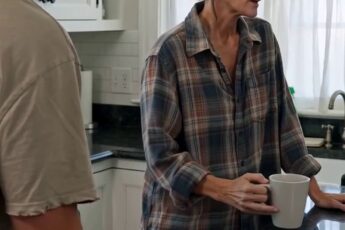
Later that evening, Owen sat at Claire’s kitchen table while snow gathered on the windowsill outside.
The room was small and warm. A yellow lamp glowed above the table. A pot of soup whispered on the stove. Ella stood on a chair, proudly sprinkling pepper while Claire pretended to be horrified.
There was banana bread cooling on a plate.
The same smell.
The same warmth.
Only this time, Owen was not alone.
Claire placed an old photograph on the table. It showed the train terminal years ago, decorated for winter. She had found it in her mother’s drawer after she passed.
In the corner of the photo, almost too blurry to notice, was a young man sitting on a bench with a foil-wrapped piece of bread in his hands.
Owen touched the picture and closed his eyes.
“I thought no one saw me,” he whispered.
Claire laid her hand over his.
“I did.”
Outside, the snow kept falling.
Inside, Ella climbed into her mother’s lap, Claire’s hand stayed warm over Owen’s, and the kitchen filled with the smell of soup, cinnamon, and something Owen had not felt in years.
Home.
Sometimes life does not give us back everything we lost.
But sometimes, in the quietest way, it returns the one thing we needed most — the reminder that we were never as forgotten as we believed.
And maybe the words we say in time can become a light someone carries for twenty years.
Have you ever had one small act of kindness stay in your heart for the rest of your life?